Wednesday, 29 January 2025

Seven Types of ITR Returns - How to Select Correct Return for Your Income Tax Filing

Introduction to ITR Returns


ITR is an abbreviation for Income Tax Return. It is a prescribed format where taxpayers provide details of their income earned during the financial year, along with the tax applicable or payable on that income. This return must be submitted to the Income Tax Department within the designated due date each year.


Who Should File Income Tax Return

An ITR is to be filed by you if you satisfy any of these following conditions:
  • If your income exceeds the minimum threshold set by the IT Act.
  • if applying for a loan or visa
  • if a tax refund is to be claimed
  • if you are receiving income from any property or assets held outside India
  • if you like to file an ITR even though your income is below the taxable limit
  • If it is a Company or Firm, irrespective of profit or loss
  • if your income includes receipts from Charitable/Endowment Trusts or other non-profit organizations, boards, trusts, etc.
  
The specific type of ITR you need to file depends on various factors, including your income, status (such as whether you are an individual, firm, company, or society), and your current domicile status.

If you are required to submit an Income Tax Return to the Indian Tax Department at the end of each financial year, it's crucial to know the correct type of return to file. While many people rely on professional tax consultants for this process, it's beneficial to understand the different types of forms available for filing with the tax authorities.

Note: The purpose of this article is to simply provide basic information regarding the different types of ITR returns and the applicable forms for your situation. Please be aware that I am not a professional; this content is intended solely for informational purposes.

Seven Types of ITR Returns


There are seven types of ITR returns, ranging from ITR-1 to ITR-7. The return you need to file depends on your total income, the nature and sources of that income, and your professional status.

ITR-1 (Sahaj)


This form applies to all salaried resident individuals and those whose total income is less than ₹50 lakh. The income includes salaries, pension, income from one-house property, and income from other sources like bank interest, deposits, agriculture income (below Rs.5,000), etc.

Who is Not Entitled to file this ITR-1:
  1. whose income exceeds 50 lacs
  2. who own more than one house
  3. individuals having income from business or profession
  4. income received from lotteries or bettings
  5. agricultural income exceeding Rs.5,000
  6. a Director or one receiving income towards capital gains
  7. one having foreign income or assets outside of India
  8. any other income not mentioned above

ITR- 2


This form applies to an individual or Hindu Undivided Family (HUF) with income from foreign assets and other sources who is not eligible to submit ITR- 1. The total income can be more than 50 lacs. He can own more than one house.

The income can include salaries, pension, income from house property, foreign income, income from lotteries and winnings, agricultural income exceeding Rs.5,000; income of spouse or child which is to be clubbed with the individual's income for assessment, income from capital gains including crypto income, etc.

Such individual need not be necessarily a Resident of India. He can be a non-resident (NRI) or resident but not ordinarily a resident (RNOR).

Who is Not Entitled to file ITR- 2 :-

Individuals with income from Business or Profession are not entitleded to file ITR- 2. (They should use either ITR- 3 or ITR- 4 as the case may be.)

ITR- 3


This form is applicable to individuals and HUF who are not entitled to submit ITR- 1, ITR- 2, or ITR- 4 provided their income includes income from Business, Profession, or Partnership Firms. Total income can exceed Rs.50 lacs.

The following are eligible to file this ITR:
  • one who is carrying on a proprietary business or profession not opted for presumptive income ( business or profession with incomes within 50 lacs are allowed to pay taxes at a presumptive rate on certain percentage of the total revenue if they do not maintain books of accounts)
  • having income from proprietary business or profession not opted for presumptive income
  • having crypto income (to be declared under business income)
  • having income from Partnership
  • their income can include salary, pension, etc.
  • any business or firm who are required to maintain books of accounts and get them audited
  • has invested in unlisted equity shares during that year
Who Cannot file ITR- 3:

Any individual with income calculated on presumptive basis can not file ITR- 3. He should file ITR-4 in such cases.

ITR- 4


This Return can be filed by an individual , HUF, or Partnership firms whose income does not exceed Rs.50 lacs but a part of the income or whole is calculated at a presumptive basis under Sections 44AD, 44AE, and 44ADA of IT Act. 

Declaration of income on presumptive basis is allowed to facilitate taxpayers indulged in small businesses (revenue not exceeding Rs.50 lacs per year).

  • Resident Indian with income from Business, Profession, Partnership (calculated on presumptive basis)
  • income from salaries, one house property, other sources including business/profession not exceeding Rs.50 lacs.
  • income as a freelancer (within that Rs.50 lac limit)
Who Cannot file ITR- 4:

  • Whose total income exceeds 50 lacs can not file ITR- 4. He should file ITR- 3 in that case.
  • If the business turnover (from which the income is derived) exceeds Rs.2 crores, he cannot file ITR- 4. In such case, he should file ITR- 3 only.
  • If owns more than one house
  • If not a Resident
  • If Director in a company
  • If owns foreign asset or income


ITR- 5


This Return is applicable to Association of Persons (AOP), Body of Individuals (BOI), Firms, and Limited Liability Partnership (LLP).
Also applies to Estates of Deceased or Insolvent, investment, and fund Business Trusts.


ITR- 6


This Income Tax Return is for Companies (provided they do not claim exemption under Section 11 of the IT Act).


ITR- 7


This Return is applicable to following individual/companies:
Section 139/4a- charitable and religiousTrusts
Section 139/4b- political parties
section 139/4c- scientific research institutions and News agencies, and Hospitals, etc.
section 139/4d- Educational institutions, Universities, Colleges, and Khadi/Village Industries  

Thursday, 23 January 2025

Income Tax Rates: Financial Year 2024-25 for Salaried and Individuals

The Income Tax Slabs and Rates were amended during previous financial years by introducing the new tax regime in 2022-2023 and making subsequent amendments.

So, from the financial year 2024-25 (AY 2025-26), our Indian government has made the new tax regime the default regime.

But, the taxpayers can opt out of the new tax regime and choose to be taxed under the old regime.

  1. For non-business taxpayers, the option can be exercised yearly while filing the ITR returns. So, they can switch back to the old regime or return to the new regime each year as per their likes and whims.
  2. However, people with income from other sources, such as business, investments, or professional services, have this option only once in their lifetime: to switch to the old regime or switch back to the new regime.

To utilize this one-time option, they must furnish Form 10-EA on or before the due date of filing the return.


Old Tax Regime vs New Tax Regime

If you choose the old tax regime, you can claim deductions under various options of Chapter VI A of the Income Tax Act, such as HRA, LIC premiums, contributions to EPF and pension schemes, interest received from banks, health insurance premiums, medical treatment, interest paid on home loans, etc.

But the above deductions are not allowed if you opt for the new regime. In such cases, only the interest paid on house loans, contributions to the Central Government Pension Scheme (14%), and contributions to the Agnipath Scheme are allowed.

In either case, you will be paying more or less the same amount of tax (as both calculations are designed to squeeze as much tax as possible, so there won't be much variation).

Now, let us have a look at the Income Tax slabs and Rates for Salaried Individuals.

Income Tax Slabs and Rates

I will provide the income tax rates for the new regime first, and then the rates under the old regime.

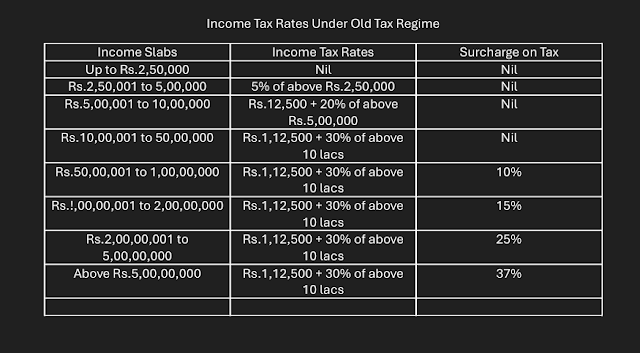
Please note that these slabs and corresponding rates apply to individuals below the age of 60 and not to others.

Slabs & Rates Under New Tax Regime:


Old Tax Regime


Note:-
Deductions under specific sections are allowed for those opting to be taxed under the Old Tax Regime as per the prevailing old practices, prior to the introduction of the New Regime. These allowances shall be discussed in my upcoming articles.


Saturday, 31 December 2022

Concepts of Total Revenue, Average Revenue, and Marginal Revenue

Let us study the nomenclature of revenue in three distinct concepts of total revenue, average revenue, and marginal revenue.


Total Revenue

Total revenue refers to the total receipts or income made in business during a period. It is the whole/gross income from the sale of goods and services and does not include other receipts. But normally, it is treated as the product of quantity sold multiplied by the price per unit sold.

So, Total Revenue = Total quantity multiplied by price per unit.
It can be represented as TR = Q*P, where TR is total revenue, Q is quantity sold, and P is the price per unit.

Average Revenue

Average revenue is the revenue or cost per unit of production or sales.
 
Generally, businessmen arrive at the average revenue by calculating the per-unit average of total expenses incurred in producing their output, which includes the value of their own minimum profit and other expenses like remuneration for staff and management. 

So they have to recover this average price through sales. The price is fixed by them accordingly. So, in most cases, the average revenue will be equal to the average cost of that product. Only then can they realize the full production cost.

Average revenue is calculated by dividing the total revenue by the number of units sold.

Average revenue = Total revenue / total quantity sold
AR = TR/ Q, where TR is total revenue and Q is quantity sold.

But we have already noticed that TR is Q*P as per our Total Revenue concept.

So, if we substitute TR with Q*P, then AR = Q*P / Q = P.
 
So, AR is the same as P. This is applicable in most of the cases.

Marginal Revenue

Marginal revenue is the amount of revenue received by selling one more unit of the product. It is the change in revenue divided by the change in quantity sold.

Under normal circumstances, if cost or price remains constant, then Marginal revenue should equal Average revenue. But, in most cases, it is not so.

This is because if there is plenty of supply, the prices will fall naturally. On the other hand, if there is a shortage of goods, people tend to pay more for them rather than forgo them. 

So, Marginal Revenue cannot be equal to Average Revenue.

This is why the need for the concept of Marginal revenue arose.

Marginal Revenue is calculated by subtracting the additional revenue earned from the total revenue.

Marginal revenue = P*(Q+1) - P*Q, where P is the price or cost per unit, and Q is the quantity.

So, MR = the revenue received by selling (Q+1) units minus the revenue received by selling Q units.

For example, if a vendor sells each pair of slippers at Rs.100 per unit and suppose he sold 20 units on one day and 21 units the next day. 

If you want to know your marginal revenue for the next day, on the second day he sold one extra unit. First day TR was 100*20 = 2000, and second day's TR was 100*21 = 2100. His MR for the second day is Rs.100. 

 But we are not concerned with the additional revenue if the price remains the same.

Marginal revenue makes sense only when prices keep escalating.

Suppose he sold 20 units for 100/per unit on the first day. 
The next day, he was able to sell 21 units and earned only Rs.2080 as he had to sell the extra unit at a lower price. 

Therefore, MR will be only Rs.80, because he earned an extra amount of only 80 (2080- 2000 = 80).

Key Facts about Average Revenue and Marginal Revenue

  • Calculation of Average Revenue is done to determine the price of a product. This helps in managing fixed costs and in determining production levels.
  • Marginal Revenue calculations help in determining sales volumes so that additional units of sale can be withheld after reaching a certain point by withdrawing the stocks from the market or by controlling production quantities.
  • Average revenue (AR) or Marginal revenue (MR) can increase or decrease depending on circumstances.
  • If fewer units are produced, AR will increase because many costs are fixed regardless of quantity, so the price per unit will be higher. Conversely, if more units are produced, AR per unit will be lower.
  • Similarly, MR changes with quantity at certain levels. If more units are sold beyond a certain point, marginal revenue per unit will continue to decrease. If fewer units are sold than the market demands, MR may increase per unit sold.
  • Average Revenue is calculated at a particular level of sales to determine the average price realized and to compare the cost price with the sale price.
  • Marginal Revenue is calculated to study the impact of selling each additional unit. It is used to control sales volume and maintain price.
  • AR and MR will be the same as long as the seller can maintain the same sale price for any volume of sales.
  • If the seller is unable to maintain the same price at each level of sales quantity, then AR and MR will vary.

Wednesday, 16 November 2016

Elasticity of Demand- Price Elasticity and Arc Elasticity Methods

Elasticity of Demand

The term 'elasticity of demand' refers to the responsiveness of demand to changes in the price of a given commodity, assuming all other factors remain constant.

To be more specific, the Price Elasticity, or "Elasticity of Demand," is a measure used to determine the percentage change in the quantity demanded of a good or service in response to a one percent change in the price of that good or service.

We are all aware that whenever the price of a commodity increases, we tend to curtail our demand for that commodity. So, the tool of the elasticity of demand tries to measure the magnitude of those changes in demand with reference to the changes in the price of that commodity.

The Elasticity of Demand is also known as the price elasticity of demand.

These terms are expressed in abbreviated form, either as "Ed" or "PED", respectively.

The elasticity of demand is mostly negative in almost all cases except in cases of "status goods" (Veblen goods) or "goods that have no substitutes" (Giffen goods).

Veblen goods are luxurious items that are the status symbols of extremely wealthy people.

Giffen goods are basic, non-luxury goods that have no substitutes. They are necessary for survival when the prices of other staple items rise. Bread, potatoes, and rice are essential for a common man to survive. So, he has to buy them when no food is available, even at higher prices.

How to Measure Elasticity of Demand?


The Elasticity of Demand is measured with the help of formulas just like Elasticity of Supply.

The general equation for Price Elasticity of Demand is expressed as follows:

Price Elasticity of Demand = Percentage change in quantity demanded divided by Percentage change in Price

So, if the original quantity is Q and the price is P, then Ed = (dQ/Q)/ (dP/P)

In the above equation, Ed denotes the elasticity of demand (price elasticity).

DQ refers to the change in quantity, and Q refers to the original quantity demanded.
DP points to the change in price, and P to the original price.

You can express the above equation as (Qd1/Qd) / (P1/P), where Qd1 denotes the changed quantity, and Qd denotes the original quantity. P1 is the new price, and P is the original price.

But we know that when prices increase, demand for those items decreases, and demand increases whenever prices fall. 

So, there is always an inverse relationship in the equation, except in the cases mentioned above. Hence, the equation always gives a negative value.

Two more precise, result-yielding formulas are being used by economists nowadays to measure the elasticity of demand. 

These formulas are as follows:

1) The Arc Elasticity of Demand formula
This method is used when there is no exact equation for demand available or when we are not accustomed to taking derivatives.

2) The Point-Price (or Price-Point) Elasticity of Demand formula
This method is used when we have the exact equation available, or when we are capable of calculating the derivatives of equations.

Now, let us study these two methods of calculation, one by one:

Arc Elasticity of Demand Method

The arc elasticity method gives us the average elasticity of demand between two end points of an arc on a demand curve. So, it gives us the average elasticity of demand for that curve. 

It solves the problem faced by analysts in choosing one point as the original point and the other point as the new point and, thereby, provides great relief from the dilemma faced by economists in calculating the elasticity. 

But it may not provide accurate figures, as you are taking the average of two points on a curve.

The mathematical equation for arc elasticity of demand is as follows:

{(P1+P2)/2} / {(Qd1+Qd2)/2} x (change in quantity demanded/change in price)

So, Elasticity of Demand according to this formula = (the average of prices divided by the average of quantities demanded at each price) x (change in quantity divided by change in price)

You are taking the average of multiple prices on an arc and dividing it by the average of new quantities demanded by consumers at those changed prices. Thereafter, you are multiplying the same by the derivative of (change in quantity divided by the change in price) at any point to decide the elasticity at that point.

Suppose there are two price levels for a commodity, sugar, at Rs. 40 per kg and Rs. 50 per kg.
Let us assume that at price 40, quantity demanded is 10 kg, and at 50, quantity demanded is 8kg.

Now, according to above formula, Ed = {(40 + 50)/2 divided by (10 + 8)/2} x {(10 - 8) divided by (40 - 50)} = (90/2 divided by 18/2) X (2/10) = (45 divided by 9) X (2/10) = 5 X 0.2 = 1
So Ed = 1

1% change in original price is 40 x 1/100 = 0.40 = 40 paise.

According to this formula, for every 40 paise, the quantity is assumed to change by 1%.

Point-price Elasticity of Demand Method

The point-price method is used to determine the elasticity of demand at very small changes in prices. 

It is useful in determining the price elasticity of demand at a specific point on the demand curve. 

It studies the changes in demand at price points very close to each other on a demand curve.

It also uses the same formula: the percentage change in demand divided by the percentage change in price. 

But instead of calculating each equation, we take information from the demand equation to calculate the price elasticity of demand.

Ed = percentage change in demand / percentage change in price = (Qd1/Qd) / (P1/P) = (P/Qd) x (Qd1/P1)

Now, as I mentioned above, this method is applied when we have the exact equation for the demand curve and the derivatives with respect to price.

Let us take an example:

The equation for the elasticity of demand for a demand curve Q = 5000 - 50P

So, in this equation, Qd1/P1 = 50 (per one unit of price, the change in quantity demanded is 50).

Now, suppose we have to find the point-price elasticity of demand at prices of 40 and 25.

The quantity demanded at 40 will be 5000-2000=3000. (multiplying 40 by 50)
The quantity demanded at 25 will be 5000-1250=3750. (multiplying 25 by 50)

So, Ed at 40 is -50 (40/3000) = -2000/3000= -2/3= -0.666
Ed at 25 is -50 (25/3750) = -1250/3750= -1/3= -0.333

Monday, 3 October 2016

Saving, Insurance and All About their Business

Saving and Insurance are two major economic activities, just like capital formation and other activities. These two are becoming a part of the daily lives of our modern economy. 

People have become somewhat aware of the insecurity of their lives and have begun to realize the need to secure their future by saving a little from their current consumption habits and by adopting insurance policies.

Saving


Need for Saving
If people go on consuming and spending all their income, and producers go on producing and thereby utilising all the resources of the economy, a day will come when there will be nothing more left to produce or to consume. So, people should curtail their consumption and spending habits and save some money and resources for future and emergency needs.

Meaning and Definition of Saving
"Saving is that portion of income or the excess value of the resources that has been left unused or unspent in a given period of time."

Saving is different from 'Savings'. 

Saving is an economic activity, whereas 'savings' is an accounting term. 

  • Savings is only a part of the total act of Saving.

In Keynesian economics, "Saving" has been defined as the excess of the amount or value left out of the available resources after consumption. 

So, saving is an economic term that points to the "total pool of savings" accumulated during a period of study.

  • The total saving of an economy can be considered as the total income or value of the resources less the total expenditure or value of the resources consumed by that economy in a given period.

Suppose a person 'X' received an income of Rs.6,00,000 during a year and spent a total of Rs.5,00,000 during that period; then, the balance of Rs.1,00,000 is his savings during that year.

So, when we add all the amounts of similar savings created by each and every member of that economy, it is the total Saving of that economy.

  • Saving not only constitutes the money saved but also includes the value of all the resources saved.

How to Save?

You can start with a very simple method. Try to be conscious of saving at every step. You can save even a few coins or rupees from your purchases and collect that money in a safe place. 

You will experience the wonderful results of that habit. After a month, you may find that you have saved as much as Rs.500 or even Rs.5,000 depending upon your saving habits and income. Now, you can deposit the money in a Bank. Maintain this practice continuously and make it a habit. This is the simplest thing to do if you are conscious of it.

Besides the above, you can save lump sums at periodic intervals, whenever you receive some extra income such as Overtime payments or Bonus, etc. 

Invest the saved amount in FD's or other Investment schemes.

Similarly, Producers and Manufacturers can also save much of their resources utilised by following some simple economic methods of production. 

  • Experiment with different ingredient ratios in production to minimize input quantities and costs.
  • Implement techniques such as identifying waste during material handling and/or leaks, and managing labor efficiency, etc.
The above are some ideas for saving resources.

Benefits of Saving to the Economy

Whenever people save some amount of their income, they generally deposit it in Banks or invest in some investments like FDs, stocks, or Debentures, etc.

Bank deposits lead to the availability of ample funds with Banks. 

As they are not going to be immediately withdrawn by all of them at the same time, Banks are naturally left with idle funds for a certain period. 

So, they can utilise these funds by lending to needy customers who are willing to take loans to meet their urgent requirements and then return the money along with some interest at a later time, either in instalments or in one lump sum.

In that way, Banks earn income from idle funds, and thereby, they can pay some "interest income" to their depositors in return for keeping funds in the bank.

  • So, you can see that the money saved by people not only creates extra income for themselves as well as for banks, in the form of interest, but it also helps other people meet their urgent and unforeseen expenses because of this saving habit of people.

Besides this, the money saved and deposited in banks or invested in shares, debentures, or government bonds helps businesses and industries further augment their production and add to the growth of the economy. 

  • The money saved results in increased production and in increased capital formation. 

  • The money invested in Government Bonds helps governments to utilise the money for public welfare programmes like constructing roads and dams, irrigation canals, parks, schools, and for many other purposes like providing subsidised schemes, midday meals to school children, etc., which all result in the welfare of the public and the growth of the economy as a whole.

Insurance

Importance of Insurance
Life is always uncertain. It is more so in this present-day world. People often get sick due to polluted water, air, and atmosphere that are causing or spreading so many viral infections. 

Impoverished roads and surging vehicular traffic are also a cause for concern, as they can result in accidents. Even the habits of people are deteriorating their health and resulting in premature deaths.
 
Natural calamities, accidents, thefts, and burglaries all cause huge loss to property. 

So, everything needs to be protected with a suitable insurance cover. Insurance provides great relief to people as it reimburses them an ample portion of the losses suffered by them.

Meaning and Definition of Insurance

Insurance is a helpful tool available for the security of the people. It is a kind of assurance from an undertaker to provide compensation for a certain loss suffered by the victim, like death, accident, fire, etc., in consideration of a nominal premium paid by him at the time of purchasing that assurance.

Insurance can be defined as "an arrangement or contract whereby a party or company facilitates its customers by providing financial compensation for the loss or damage incurred by them". 

It is generally represented by a policy that guarantees to indemnify against loss in consideration of a one-time or periodic premium paid by the victim.

Insurance Business and Income to Insurance Companies

An insurer bears the risk and assumes the responsibility of reimbursing the insured person a certain percentage or amount of loss, in the event of loss or damage as covered in the agreement.

As a return for their services, they collect monthly or periodic insurance premiums from their customers as their charges. 

Since people are always insecure about their lives, properties, and health, they look to these insurance coverages as their refuge. 

Many people opt to purchase these insurance policies. As a result, the insurance business generates a large pool of funds for the insurance company, from which reimbursements are made to customers who incur losses.

But the actual losses incurred by customers may not occur during the same period. Furthermore, not all customers suffer losses in reality. Only a portion of them will claim reimbursements at any given period. 

So, the companies can invest most of the money collected in profit-yielding investments or in real estate businesses and thus earn good profits from their insurance business.

The premiums are calculated to include all expenses of the company so that they can withstand any claims of huge losses and still sustain their business. 

By managing the risk in an intelligent and smart way and by evaluating the weak points minutely in all respects, the insurance companies can make ample profits and minimise their incumbent reimbursement occasions.

Different Types of Insurance Policies

There are many types of insurance policies to cover different types of losses.

a) Life Insurance
The life of a person is insured under this cover. 

Insurance companies examine the individual's health history and determine the amount to be reimbursed under the policy. Normally, younger people can opt for higher coverage with lower premiums, whereas older people are covered only for lower amounts, and even then at higher monthly premiums. This is because older people's life expectancy cannot be predicted as accurately, and it is riskier for insurance companies to underwrite their policies.

b) Health Insurance 
Health insurance policies cover hospitalization and medical expenses. 

These policies also require periodic premium payments to cover these expenses. The policies are issued annually.

The health of the person concerned is thoroughly examined before determining the amount to be reimbursed. You can renew policies annually. Most MNCs provide their employees with this health insurance coverage nowadays. Medical expenses are reimbursed by insurance companies after verifying the bills and expenses. Some expenses are not reimbursed during the process because they are deemed unnecessary by the insurers.

c) Personal Accident Insurance
Personal accident policies cover injury or death resulting from accidents. They cover only accident-related cases. 

The sum assured is generally limited to 5 or 6 years of the person's job earnings. It does not take into account other income. If the insured dies or suffers a serious, irrecoverable loss of limbs, the insurer will reimburse the full sum assured. Otherwise, only a portion of the sum assured is paid based on its norms. The insured needs to pay a premium to activate the policy.

d) Auto Insurance
Auto insurance covers the damages incurred by vehicles due to accidents or other calamities. The insurance amount is calculated based on the value of the vehicle according to its ageing factor also. A new vehicle can be insured for its whole cost with a higher premium payment. Old vehicles are insured for their residual value only with lower premium payments.

5) Other Insurance Policies
There are many other insurance options available for almost all kinds of damages or losses suffered by people. 

Some of them are Fire Insurance, Theft or Burglary Insurance, Marine Insurance (for losses suffered during shipwrecks, etc.), Fidelity Insurance (losses due to dishonesty, etc. during employment), Travel Insurance, Credit Insurance (loss due to bad debts), Crop Insurance (for farmers due to natural calamities), Workmen Compensation Insurance (loss incurred during employment due to negligence of employer resulting in accidents).