Showing posts with label finance. Show all posts

Tuesday, 15 September 2026

Modern Concept of Inventory vs Traditional Concept

In modern AI- and IT-enhanced environments, the term "inventory" can refer to both physical and non-physical assets, depending on the industry. So, modern businesses have begun to apply inventory control frameworks to non-physical and digital items.

The traditional concept of inventory is strictly applied to physical goods like raw materials, work-in-progress items, finished goods, and store items.

Let us study which products and assets are included in the modern concept of inventory management.

Non-Physical and Digital Assets in Inventory Control

The following are some of the items under the modern concept:

Digital Products: 

Companies selling ebooks, software downloads, streaming licenses, video games, or online courses, etc. 

These companies must control their digital stock levels, server bandwidth capacities, and product key allocations.

Service-Based Industries:

Airlines, hotels, or consulting firms treat their service capacity, time, and space as inventory. 

Inventory control here means managing non-physical assets, like seat availability, room accommodations and services, or billable consultant hours, etc.

SaaS (Software as a Service) and Cloud Resources: 

In IT inventory management, organizations track and control virtual machines, cloud storage blocks, data containers, and user subscriptions to avoid over-purchasing.

Intellectual Property (IP): 

Media and entertainment businesses prepare lists of their properties, track, and manage the distribution rights and usage licenses of their digital content.


Inventory Control vs. Asset Management

Even though inventory control extends to digital and non-physical goods, it remains strictly separate from asset management.

  • Strictly speaking, inventory control refers to the management of physical and tangible goods.
  • Inventory control is applied to manage the stocks (purchases, issues/consumption, and sales)
  • So, inventory control is the management of saleable stocks and products.
But Asset Management is the management and control of a business's assets. The following list of items is dealt with by Asset Management. It does not include inventory stocks like stores & spares or products of the business.


Groups of Asset Management:

Financial Assets: Cash, bank balances, or accounts receivable/debtors.

Fixed Capital Assets: Corporate real estate, office furniture, and machinery.

Corporate Intangible Assets: Company goodwill, trademarks, and brand reputation.


The distinguishing rule that separates asset management from Inventory Control is the purpose:

Inventory control monitors items intended for sale, distribution, or consumption in production. 

Asset management monitors items the company owns to run its business operations.

Thursday, 16 July 2026

Tax Year and Key Points For ITR Filing: Tax Year 2026-27

From 1st April 2027, the existing terminology of "Assessment Year" and "Financial Year" becomes void. They are replaced by a single term, "Tax Year".

For the 2026-27 tax year, you will file your ITR on or before July 31, 2027, if you are a salaried individual, pensioner, student without business income, or anyone else not subject to tax audit.

Those subject to Tax Audit have (time) until August 31.

The following are some of the salient features I observed for Tax Year 2026-27 onward.


Tax Filing Deadlines and Points to Note for "Tax Year 2026-27"

ITR due date/deadline: 

The due date for filing income tax returns is extended from 31 July to 31 August for non-audit business/professional taxpayers and partners of non-audit firms. For non-business assessees, the 31st July due date continues unchanged.

ITR-U (Updated Return) due date: 

Taxpayers can file an updated return even after receiving a reassessment notice, within the time allowed in that notice. This is allowed on payment of tax, interest, and an additional 10%, and the disclosed income will get immunity from under-reporting/misreporting penalty.

Revised ITR Filing: 

The time limit for filing a revised return has been extended from 9 months to 12 months from the end of the relevant year (or before assessment, whichever is earlier). 

However, if the revised return is filed after 9 months, a fee of Rs. 1,000 (for income up to Rs. 5 lakh) or Rs. 5,000 (for other cases) will be payable.

Quoting of PAN is Mandatory on Purchases: 

Section 262(10)(c) is amended to allow the CBDT (Central Board of Direct Taxes) to mandate quoting of PAN even for non-business/non-professional transactions. This aligns the ITA 2025 with the existing provisions of the ITA, 1961. For example, buying jewellery or other goods above Rs 2 lakh needs a PAN number.

Loss in ITR-U (Updated Return Filing for Corrections in Loss): 

The Finance Bill 2026 proposes that an updated return will be allowed even if the original return was a loss return, provided the updated return reduces the loss amount. This change enables voluntary correction, as reduced losses result in higher taxable income.

Key Changes in Income Tax Forms

Form 15G/H is merged and unified into Form 121

Form 16 is now Form 130

Form 26AS is Form 168

Tax Audit Forms 3CA, 3CB, and 3CD are merged into a single Form No. 26.

Wednesday, 15 July 2026

Important Changes in Tax Return Filing for AY 2026-27 (FY 2025-26) and Onward

What are the biggest changes to tax deductions this year, and how do they affect me?

Please remember that AY refers to the Assessment Year in taxation, not to the Accounting Year.
Accounting Year is known as the Financial Year (FY)

Important Changes in the Income Tax Act and Tax Filing


1) New Legislation: The Income Tax Act, 2025, replaces the 1961 Act starting April 1, 2026.

2) Deadline Changes: The filing deadline for non-audit business cases has been extended from July 31 to August 31. For Business entities and audit-mandated firms, the last date is 31st July 2026.

3) Terminology Shift: The new Act is moving toward the term "Tax Year" instead of "Assessment Year" for future filings.

4) Introduction of a simplified New Tax Regime, which will become the default Tax Regime from Financial Year 2026-27. So, if you prefer to be taxed under the Old Regime, you should voluntarily choose it each year. Otherwise, you will be taxed by default under the New Regime (if you forget to choose any particular year) and there will be no trace back to the Old Regime.


There is no change in the deadline for the salaried class. The last date, in their case, is 31st July, 2026 for Financial Year 2025-26.


For the 2025–26 filing season (income you earned in 2025-26), the biggest changes in deductions are higher standard deduction amounts, a much larger SALT (state and local tax) cap, several new or expanded special deductions, and the continued emphasis on the “New” simplified tax regime versus the traditional deduction-heavy regime.

The impact depends on your income level and whether you itemize or use the standard deduction.


For Indian residents, most changes in 2026 are about regime choice and gradual restructuring of deductions, not about big new individual deduction sections.

The new tax regime under section 115BAC continues as the default with simplified slabs and limited deductions, while the old regime with popular deductions like 80C (investments), 80D (health insurance), and 10(10D) (life insurance maturity) remains available if you opt for "Old" instead of the default "New Regime".

For Tax Year 2027-28 (Income earned during 2026-27)


Policy discussions and draft rules for FY 2026–27 point toward consolidating many scattered exemptions and deductions into fewer, broader categories over time, with an explicit push to make more people stay in the new regime. The final decisions are still under process.

Points to Consider While Filing the Return for AY 2026-27 (Income During FY 2025-26)


If you usually claim a lot of deductions (EPF/PPF/ELSS under 80C, medical premiums under 80D, home loan interest under 24(b), etc.), you may still save more by staying with the old regime for now, but you need to compare both regimes each year.


If your salary structure is simple and you don’t invest heavily just for tax saving, you may pay less tax or file more easily in the new regime, since rates are lower and compliance is lighter, even with fewer deductions.


From April 2026, some interest deductions against dividend and mutual fund unit income are being withdrawn, which can slightly increase tax if you borrow to invest.

Thursday, 19 March 2026

Revised Return Filing Rules and Deadlines

 Under the current Income Tax Act of India, the revision window for filing a revised Income Tax Return (ITR) under Section 139(5) is as follows: 

1. The Revision Deadline (As of AY 2025-26)

A revised return must be filed within the (below-mentioned) time frame, whichever is earlier: 

  • i) December 31st of the relevant Assessment Year (AY). 
  • ii) before the completion of the assessment by the Income Tax Department, if the assessment is done earlier. 

Example: 

For the Financial Year (FY) 2024-25, the Assessment Year is 2025-26. The last date to file a revised return is 31 December 2025, provided the assessment is not completed before that. If the assessment is done earlier, say within September 2025, the revised return is to be filed within that period.

Note:

So, if you have missed that opportunity to file a revised return (for any mistakes/omissions), you can no longer file a Revised Return. But, there is a chance to file an Updated Return, which is explained at the bottom of this post.

2. Important Rules for Revision 

  • Eligibility: You can revise your return if you discover any error or omission in your original ITR.
  • Late Filed Returns: A belated return (filed after the original due date) can also be revised within this timeframe. 
  • Multiple Revisions: There are no restrictions on how many times a return can be revised, as long as it is submitted by the deadline. 
  • Original Return: The revised return completely replaces the original return. 


What to Do if I Miss the Deadline? 

If the 31st December deadline is missed, you cannot file a regular revised return. 

However, you can file an Updated Return (ITR-U) under Section 139(8A) within 24 months from the end of the relevant assessment year, subject to payment of additional taxes/penalties. 


Future Changes for Revised Return Filing (Budget 2026 Proposal) 

According to recent announcements in the Budget 2026 (for FY 2025-26 onwards), the deadline for filing revised returns is proposed to be extended to 31st March of the Assessment Year (i.e., 12 months after the end of the financial year, instead of 9 months), with a nominal fee applied after 31st December. 

Note: 

For the Financial Year 2024-25, the 31st December 2025 deadline still applies, which already expired on 31st December 2025. So, you should file an Updated Return (not the Revised Return). 

For the Financial Year 2025-26, the deadline allows you to submit Revised Returns till 31st March 2027(if duly passed and enforced by the IT Department) by paying a nominal fee for the period 1st January to 31 March 2027.

Monday, 23 February 2026

PAN Card- How to Apply and Documents Required for PAN Application


 Online PAN card application for Indian citizens involves filling out Form 49A and submitting it on the Protean e-Gov Technologies website (formerly NSDL) or/alternatively on the UTIITSL portal (https://www.pan.utiitsl.com/PAN/), paying fees (approx. ₹91 + GST), and an Aadhaar-based e-KYC for a paperless process.


You can opt for "Submit through scanned images" if you are not okay with e-KYC.

UTIITSL and Protean (formerly NSDL) are both authorized agencies for PAN card services in India, offering equally valid, government-accepted documents. Protean is known for strong digital infrastructure and a larger network, while UTIITSL (often) provides faster processing and wider physical, center-based support.


Key Differences: Protean vs UTIITSL 


Protean eGov Technologies (formerly NSDL):


  •  Highly digital with a vast network of 73,000+ TIN-FC centers. (Tax Information Network Facilitation Centers authorised by the Income Tax Department of India.
  • Online applications, quick e-PAN generation, and comprehensive digital services.
  • Can process a large volume of PAN applications simultaneously.


UTIITSL (UTI Infrastructure Technology And Services Limited): 


• Physical, on-the-ground support with a strong presence in smaller cities. 

• Best for: Applicants preferring physical centers for assistance. 

• Speedy and often reported to have slightly faster processing times.

Here is the link for Protean e-Gov Technologies Online Pan Card Services platform.


An e-PAN is issued via email within two days, and the physical card is sent by post. You may download an instant e-card after successfully submitting your application.

Key Steps for Online PAN Application: 

These are the processes involved in applying for a PAN through Protean services-


• Registration: Visit the Protean (formerly NSDL), select 'New PAN - Indian Citizen (Form 49A)', and fill in personal details in the form. 

• Submission Mode: Choose between these two choices- 

1) 'Submit digitally through e-KYC & e-Sign' (paperless, no documents needed) or 

2) 'Submit scanned images through e-Sign' (requires uploading photo, signature, and documents). 

If you opted for the first one, ensure your Aadhaar is linked with your registered mobile, as an OTP will be sent to that mobile. So keep the mobile and the Aadhaar Card with you. 

• Submission is done through Aadhaar-Based e-KYC: Enter Aadhaar details for authentication. The photo on the Aadhaar card can be used for the PAN card. 

• Details & Payment: Fill in the details for payment mode, then pay the application fee (around ₹91 for Indian addresses). 

• Verification: E-verify the application using the OTP sent to the Aadhaar-linked mobile number. 

• Acknowledgement: A 15-digit acknowledgement number will be generated to track the status. 

• Processing Time: An e-PAN is typically sent via email within 2 days, while the physical PAN card will be dispatched (more or less) in 15 days.

You may download the receipt and keep it for reference till then.


Documents Required (for non-eKYC method): 


• Proof of Identity: Aadhaar card, voter ID, passport, or driving license. 

• Proof of Address: Aadhaar card, utility bills, or bank account statement duly printed on the stationery of the bank with their logo and address of the branch and containing the signature of the issuing authority with date, seal, and designation. 

• Proof of Date of Birth: Birth certificate, Aadhaar card, or high school/ matriculation certificate.

For an exhaustive list of valid/acceptable documents, you may visit this link


Note:

For immediate needs, an Instant e-PAN can be generated via the Income Tax e-Filing portal (https://www.incometax.gov.in/iec/foportal/help/how-to-generate-instant-e-pan), using your Aadhaar card, in a matter of minutes. 

Monday, 26 January 2026

Tax Residency Certificate: How to Obtain Form 10FB

 Form 10FA is an application to request a Tax Residency Certificate from the Income Tax Department. After scrutiny and approval, the TRC is issued in Form 10FB by the tax department.

Purpose of Tax Residency Certificate (Form 10FB)

To prevent double taxation, Sections 90, 90A, and 91 provide taxpayers with options to claim benefits and pay tax on their foreign income only once. Both tax credit/refund and relief are applicable, depending on the presence (or absence) of DTAA with the country/organisation, or the nature of the business of the applicant with that entity. DTAA stands for the Double Taxation Avoidance Agreement under Section 90 of the Indian IT Act.

A tax residency certificate is mandatory for obtaining relief from tax being deducted by foreign agencies (to avoid duplicate tax deductions) in which you have certain interests. The certificate (Form 10FB) is provided after your application gets approved by the department. It may take two to four weeks, depending on your activities.

Filling out and submitting the application form (10FA) typically takes 15 to 30 minutes, provided you have all the necessary details and supporting documents ready. The process is straightforward and requires basic information such as PAN, address, and the financial year for which the certificate is needed.

Factors Affecting Time and Process 


Procedure: 

The time depends on having the necessary documents ready, such as a PAN, proof of residence, and details of the income source, all of which must be readily available. As proof of residence, you can provide the recent (last month) electricity bill. Sometimes, the bills bear the builder's name or the owner's name. In such circumstances, you need to support the bill with a sale deed or rental agreement (if a tenant).  

Document Upload: 

You will need to upload supporting documents in PDF or ZIP format (max size 5MB each). 

Verification: 

After filling the form, you must verify it using an OTP sent to your registered mobile and/or email, or via digital signature (DSC). 

Processing Time: 

While the filing time is short, obtaining the Certificate of Residence (Form 10FB) after submitting Form 10FA can take 2 to 4 weeks. 

The Tax Residency is valid for the year for which you apply. So, you should seek a fresh certificate each year if you are in need of it.


Steps to Complete Form 10FA Online 


1. Login: Log in to the Income Tax e-Filing portal.
 
If you don't have an account on the Income Tax Portal, you need to create one or use other offline methods as mentioned at the end of this article. To create an account, you should provide your PAN number, mobile number, and other required details. You should also link your Aadhar Card to use the services.

2. Navigate: Go to 'e-File', 'Income Tax Forms', and click 'File Income Tax Forms'. 

3. Form Selection: Search for and select Form 10FA. 

4. Fill Data: Enter personal details, PAN, address, and financial year details. 

5. Upload Documents: Upload supporting documents. 

6. Verify & Submit: Verify using OTP (mobile/email) and submit.

You will be notified when the certificate is ready for download.

Obtaining TRC through Offline Mode

If you find it difficult to procure the certificate through an online application, you can take the services of any Tax Consultant or Chartered Accountant. They may charge some nominal fees for this work. You will have to provide the details and the documents necessary for this purpose. ClearTax is a consultancy firm that offers these services, as per my knowledge. They can do all your income tax jobs.

Tuesday, 20 January 2026

Do You Know? Income Tax Department Indulges in NUDGE Awareness Campaigns


In common usage, a nudge means the act of pushing your friend/neighbor with the elbow. It is a way of drawing his attention to something that you want to. This act of pushing is adopted by our (Indian) Income Tax Department to alert taxpayers to rectify their mistakes before issuing any notices.


The NUDGE in Indian Income Tax stands for "Non-Intrusive Usage of Data to Guide and Enable". It is a campaign by the Central Board of Direct Taxes (CBDT) that uses advanced data analytics to identify potential discrepancies in a taxpayer's filed return and encourages them to voluntarily correct the errors.

According to TOI's article (linked at the bottom) dated December 25, some taxpayers received these SMS's/emails. 

Key Aspects of the NUDGE Campaign:

Advisory Nature: 

The communication (via SMS and email) is advisory and not a formal legal notice or the start of an intrusive investigation. It reflects a "trust-first" approach by the tax department to promote voluntary compliance.

Data-Driven: 

The campaign utilises data analytics and information received from various sources, including international information exchange agreements (such as AEOI, CRS, and FATCA), to identify high-risk cases.

Specific Issues: 

The campaign targets particular issues, such as:

  • Ineligible deductions or exemptions claimed (e.g., bogus donations to unrecognised political parties).
  • Incorrect or invalid Permanent Account Numbers (PANs) of donees or other entities.
  • Non-disclosure or underreporting of foreign assets and foreign source income in the ITR's Schedule FA and Schedule FSI.
  • Other issues of importance.

What to Do When You Receive a Nudge Message 

Taxpayers who receive a NUDGE message are advised to review their Income Tax Returns (ITRs) for discrepancies and, if necessary, file a revised return within the specified deadline (e.g., by December 31 for the relevant assessment year) to avoid potential penalties or a detailed investigation later.

Taxpayers are advised to carefully verify all deductions and exemptions claimed on their returns against supporting documents to ensure accuracy and compliance.

If discrepancies are identified, taxpayers should correct the figures and file a revised return on or before December 31 to avoid penalties, additional tax liabilities, or further scrutiny by the department.

Individuals whose claims are genuine and in accordance with the law do not need to take any further action. 

However, they may retain documentation in case verification is requested by the department.

Key deductions under scrutiny include House Rent Allowance, donations to political parties, foreign source receipts/payments, and exemptions under the Double Taxation Avoidance Agreement.

We should note that the NUDGE initiative is part of the department’s trust-first approach, which aims to provide taxpayers with an opportunity to voluntarily correct errors in their returns without facing immediate enforcement action. So, we should be thankful and appreciate their cooperation.

For some more news, please read this article from The Times of India dated December 25, 2025.

Monday, 19 January 2026

What is AIS in Income Tax Returns and How it Differs from Form 26AS

A sample of the front page


 An AIS, or Annual Information Statement, is a detailed report introduced by India's Income Tax Department. 

It enables a consolidated view of a taxpayer's financial transactions executed during a year, aiming to encourage voluntary compliance and assist in the pre-filling and submission of Income Tax Returns (ITR). 

This auto-generated statement is available on the Income Tax Portal. This information is compiled automatically by the Tax Department from data collected from various third-party entities that are legally mandated to report financial transactions associated with a taxpayer's Permanent Account Number. 

The AIS contains two Parts- A (providing general information of the taxpayer) and B (financial transactions done by or related to him).

The length of the statement depends on the volume of transactions mentioned under 57 categories of income and expenses in Part B.

Key Details and Features

1. Comprehensive Data Compilation

The AIS includes a broad range of information reported by various entities (like banks, employers, mutual funds, stock exchanges, etc.) using your Permanent Account Number (PAN).

Even the LIC and PF organisations provide their statements regarding your premiums, contributions, etc., to the Tax Department.

 The data thus provided includes:

Salary, interest (from savings accounts, FDs, etc.), and dividend income, if any.

LIC premiums paid in a year and maturity/claims paid.

PF contributions and funds drawn during the said year.

Details of Securities and Mutual Fund transactions.

High-value transactions involving property purchases/sales and large cash deposits/withdrawals.

Foreign Remittances and purchases of foreign currency.

Details of tax payments like TDS, TCS, advance tax, and self-assessment tax.

Any other financial transactions executed during that year with other entities.

2. Taxpayer Information Summary (TIS)

The AIS is accompanied by a simplified summary called the TIS, which provides an aggregated, category-wise view of your financial data. This summary enables the calculation of Income Tax dues and the balance amount of tax payable. 

The derived value from TIS is used for pre-filling your ITR.

3. Feedback Mechanism for Rectification and Claims

Taxpayers can submit online feedback if they find any incorrect, duplicated, or unfamiliar information in the AIS. 

This feature helps in reconciling data and ensures accuracy before filing the ITR.

4. Accessibility and Available Formats for Download

The AIS can be accessed via the official Income Tax e-filing portal (navigating to the Annual Information Statement under the "Services" tab).

It can be downloaded in various formats, including PDF, JSON, and CSV. 

A mobile app, "AIS for Taxpayer," is also available and can be downloaded from the Google Play Store or the Apple App Store.

AIS vs. Form 26AS

AIS is an extension and a more detailed version of the traditional Form 26AS. While Form 26AS primarily focuses on TDS/TCS details, AIS captures a much wider array of financial information, often including transactions where no tax was deducted. 

Form 26AS is the old format, which has been revamped and enhanced into a comprehensive format type now designated as the Annual Information Statement.

Form 26AS may become obsolete in due course.

Importance of AIS for Taxpayers

Reviewing your AIS is crucial before filing your ITR to ensure all income sources are accurately reported, which helps in:

  • Avoiding omissions or under-reporting of income
  • Minimizing the risk of receiving tax notices from the Income Tax Department
  • Ensuring that the tax credits claimed match the data available to the tax authorities. 

You can access your AIS from the IncomeTax Portal or through the mobile app.

Saturday, 1 February 2025

Documents and Forms Needed to File Your ITR Returns

As we all know, an income tax return is a form to be filled out and submitted by each taxpayer before the due date of filing the returns as stipulated in the Income Tax Act. The return is to be filled based on information gathered from reliable documents.

Individuals, HUFs, and Firms with income above the basic exemption limit must file Income Tax Returns yearly, disclosing their total income along with perquisites and details of tax paid or deducted at source, taxable income, tax liability, or refundable dues. 

While doing so, they are required to keep certain documents on hand to support their figures.

In this article, let us study the details of such documents.

I am providing the information regarding some of those documents in the below sections.

Important Documents Needed for Submission of ITRs


Some of the documents that serve as the base for filing a return are as follows:
  • PAN card
  • Salary slips or income statements
  • Bank Statements
  • Form 16, 16A, 16B, 16C (whichever applicable)
  • Form 26AS
  • Form 15G or 15H
  • TDS certificates
  • Interest certificates, if any
  • Investment Documents
  • Documents of Loans on Houses or Assets purchased during the year
  • Any other documents needed to support the claims


Form 16

Form 16 is a document provided by an employer to his employee certifying Tax Deducted at Source during a Financial Year from the payments made to him.

This form provides details of Gross Salary and perquisites like HRA, LTA, etc. It further contains information regarding other incomes reported by the employee and exemptions granted under certain clauses of the IT Act, net taxable income, and TDS deducted.

This serves as the major document for filing the ITR.

Form 16A, Form 16B, and Form 16C

  • Forms 16a, 16b, and 16c deal with tax deducted from incomes other than salary.
  • Form 16a provides details of tax deducted from income generated through securities, investments, FDRs, Rent, etc. These are provided by the respective agent deducting the TDS.
  • Form 16b deals with tax deducted from earnings on the sale of immovable property or property dealings. The person buying the property should issue this certificate.
  • Form 16c is a TDS certificate issued by a person paying rent to his land lord. It contains the amount of gross rent payable and the amount of TDS deducted while paying the rent to his owner. The amount so deducted by the payee is to be deposited to the Income Tax Department through challan within 15 days of the deduction.


Form 26AS

Form 26AS is a consolidated statement of TDS deducted from the taxpayer's remunerations during a year by different entities (like employer, banks, and other sources). Besides TDS, this form contains figures of Self-Assessment Tax, Advance Tax remittances, and certain other financial transactions done during the said year.

This Form is available to taxpayers on the Income Tax Department's portal. As and when remittances are done, the statement gets updated simultaneously. You can download the form and tally the figures with your records and, if any discrepancies, raise the issues for solution with the department.

This form plays a crucial role while filing your ITR return. You must verify the figures before filing of the ITR return.

Form 15G

Form 15G is a document certifying that the income of the person holding it falls within the non-taxable bracket. This form is issued to individuals aged 60 and below. The holder of this form can submit it to the concerned authority (banks, etc.) for not deducting TDS from any payments that he may be receiving from them.  

Form 15H
Form 15H is for senior citizens whose income falls within the non-taxable bracket. It serves a similar purpose to that of Form 15G.

Other Documents

Other forms and documents, such as PAN cards, salary slips, TDS certificates, loan documents, interest certificates, investment certificates, rent agreements, and property sale documents, must be kept in the taxpayer's records before filing the tax returns.  

These documents are essential for verifying the figures and for accurately filing the ITR. Additionally, they may be required if the Tax Department requests them.

Wednesday, 29 January 2025

Seven Types of ITR Returns - How to Select Correct Return for Your Income Tax Filing

Introduction to ITR Returns


ITR is an abbreviation for Income Tax Return. It is a prescribed format where taxpayers provide details of their income earned during the financial year, along with the tax applicable or payable on that income. This return must be submitted to the Income Tax Department within the designated due date each year.


Who Should File Income Tax Return

An ITR is to be filed by you if you satisfy any of these following conditions:
  • If your income exceeds the minimum threshold set by the IT Act.
  • if applying for a loan or visa
  • if a tax refund is to be claimed
  • if you are receiving income from any property or assets held outside India
  • if you like to file an ITR even though your income is below the taxable limit
  • If it is a Company or Firm, irrespective of profit or loss
  • if your income includes receipts from Charitable/Endowment Trusts or other non-profit organizations, boards, trusts, etc.
  
The specific type of ITR you need to file depends on various factors, including your income, status (such as whether you are an individual, firm, company, or society), and your current domicile status.

If you are required to submit an Income Tax Return to the Indian Tax Department at the end of each financial year, it's crucial to know the correct type of return to file. While many people rely on professional tax consultants for this process, it's beneficial to understand the different types of forms available for filing with the tax authorities.

Note: The purpose of this article is to simply provide basic information regarding the different types of ITR returns and the applicable forms for your situation. Please be aware that I am not a professional; this content is intended solely for informational purposes.

Seven Types of ITR Returns


There are seven types of ITR returns, ranging from ITR-1 to ITR-7. The return you need to file depends on your total income, the nature and sources of that income, and your professional status.

ITR-1 (Sahaj)


This form applies to all salaried resident individuals and those whose total income is less than ₹50 lakh. The income includes salaries, pension, income from one-house property, and income from other sources like bank interest, deposits, agriculture income (below Rs.5,000), etc.

Who is Not Entitled to file this ITR-1:
  1. whose income exceeds 50 lacs
  2. who own more than one house
  3. individuals having income from business or profession
  4. income received from lotteries or bettings
  5. agricultural income exceeding Rs.5,000
  6. a Director or one receiving income towards capital gains
  7. one having foreign income or assets outside of India
  8. any other income not mentioned above

ITR- 2


This form applies to an individual or Hindu Undivided Family (HUF) with income from foreign assets and other sources who is not eligible to submit ITR- 1. The total income can be more than 50 lacs. He can own more than one house.

The income can include salaries, pension, income from house property, foreign income, income from lotteries and winnings, agricultural income exceeding Rs.5,000; income of spouse or child which is to be clubbed with the individual's income for assessment, income from capital gains including crypto income, etc.

Such individual need not be necessarily a Resident of India. He can be a non-resident (NRI) or resident but not ordinarily a resident (RNOR).

Who is Not Entitled to file ITR- 2 :-

Individuals with income from Business or Profession are not entitleded to file ITR- 2. (They should use either ITR- 3 or ITR- 4 as the case may be.)

ITR- 3


This form is applicable to individuals and HUF who are not entitled to submit ITR- 1, ITR- 2, or ITR- 4 provided their income includes income from Business, Profession, or Partnership Firms. Total income can exceed Rs.50 lacs.

The following are eligible to file this ITR:
  • one who is carrying on a proprietary business or profession not opted for presumptive income ( business or profession with incomes within 50 lacs are allowed to pay taxes at a presumptive rate on certain percentage of the total revenue if they do not maintain books of accounts)
  • having income from proprietary business or profession not opted for presumptive income
  • having crypto income (to be declared under business income)
  • having income from Partnership
  • their income can include salary, pension, etc.
  • any business or firm who are required to maintain books of accounts and get them audited
  • has invested in unlisted equity shares during that year
Who Cannot file ITR- 3:

Any individual with income calculated on presumptive basis can not file ITR- 3. He should file ITR-4 in such cases.

ITR- 4


This Return can be filed by an individual , HUF, or Partnership firms whose income does not exceed Rs.50 lacs but a part of the income or whole is calculated at a presumptive basis under Sections 44AD, 44AE, and 44ADA of IT Act. 

Declaration of income on presumptive basis is allowed to facilitate taxpayers indulged in small businesses (revenue not exceeding Rs.50 lacs per year).

  • Resident Indian with income from Business, Profession, Partnership (calculated on presumptive basis)
  • income from salaries, one house property, other sources including business/profession not exceeding Rs.50 lacs.
  • income as a freelancer (within that Rs.50 lac limit)
Who Cannot file ITR- 4:

  • Whose total income exceeds 50 lacs can not file ITR- 4. He should file ITR- 3 in that case.
  • If the business turnover (from which the income is derived) exceeds Rs.2 crores, he cannot file ITR- 4. In such case, he should file ITR- 3 only.
  • If owns more than one house
  • If not a Resident
  • If Director in a company
  • If owns foreign asset or income


ITR- 5


This Return is applicable to Association of Persons (AOP), Body of Individuals (BOI), Firms, and Limited Liability Partnership (LLP).
Also applies to Estates of Deceased or Insolvent, investment, and fund Business Trusts.


ITR- 6


This Income Tax Return is for Companies (provided they do not claim exemption under Section 11 of the IT Act).


ITR- 7


This Return is applicable to following individual/companies:
Section 139/4a- charitable and religiousTrusts
Section 139/4b- political parties
section 139/4c- scientific research institutions and News agencies, and Hospitals, etc.
section 139/4d- Educational institutions, Universities, Colleges, and Khadi/Village Industries  

Thursday, 23 January 2025

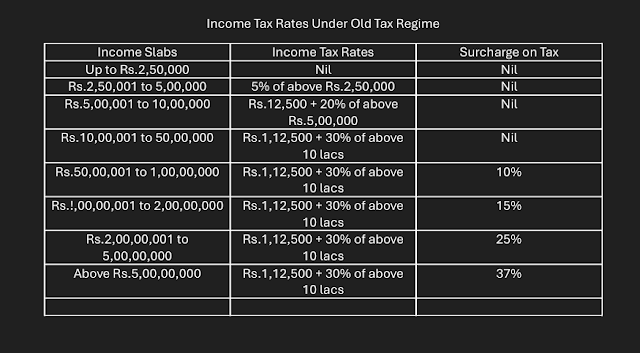
Income Tax Rates: Financial Year 2024-25 for Salaried and Individuals

The Income Tax Slabs and Rates were amended during previous financial years by introducing the new tax regime in 2022-2023 and making subsequent amendments.

So, from the financial year 2024-25 (AY 2025-26), our Indian government has made the new tax regime the default regime.

But, the taxpayers can opt out of the new tax regime and choose to be taxed under the old regime.

  1. For non-business taxpayers, the option can be exercised yearly while filing the ITR returns. So, they can switch back to the old regime or return to the new regime each year as per their likes and whims.
  2. However, people with income from other sources, such as business, investments, or professional services, have this option only once in their lifetime: to switch to the old regime or switch back to the new regime.

To utilize this one-time option, they must furnish Form 10-EA on or before the due date of filing the return.


Old Tax Regime vs New Tax Regime

If you choose the old tax regime, you can claim deductions under various options of Chapter VI A of the Income Tax Act, such as HRA, LIC premiums, contributions to EPF and pension schemes, interest received from banks, health insurance premiums, medical treatment, interest paid on home loans, etc.

But the above deductions are not allowed if you opt for the new regime. In such cases, only the interest paid on house loans, contributions to the Central Government Pension Scheme (14%), and contributions to the Agnipath Scheme are allowed.

In either case, you will be paying more or less the same amount of tax (as both calculations are designed to squeeze as much tax as possible, so there won't be much variation).

Now, let us have a look at the Income Tax slabs and Rates for Salaried Individuals.

Income Tax Slabs and Rates

I will provide the income tax rates for the new regime first, and then the rates under the old regime.

Please note that these slabs and corresponding rates apply to individuals below the age of 60 and not to others.

Slabs & Rates Under New Tax Regime:


Old Tax Regime


Note:-
Deductions under specific sections are allowed for those opting to be taxed under the Old Tax Regime as per the prevailing old practices, prior to the introduction of the New Regime. These allowances shall be discussed in my upcoming articles.


Sunday, 29 March 2015

What is Break-Even-Point? How to Calculate the Break-Even Point in Businesses

The break-even point is the level of business activity at which a firm's total revenue equals its total costs, so there is no profit or loss. At this point, the cost of production and the price match each other. From this point, you can move toward profit by improving your operations efficiently, or, on the other hand, you may incur losses due to mismanagement and defective planning.

Break-Even Point Definition

Break-Even Point can be defined as a point in business scale at which the value of total costs equals total sales or revenue at any point in time. 

It is a point where expenses equal income, and there is neither profit nor loss in the operations of the business. The values of sales and production of the business break even at this point on a curve or line joining the costs and revenues.

Importance of Break-Even Point

  • Break-even points help calculate the minimum level of output that must be exceeded to make a profit in business. In other words, you can determine the minimum quantity of sales required to cover all expenses and generate an additional unit of profit.
  • The business owner can determine the minimum number of units that must be produced and sold to cover both fixed and variable costs, so that profits can begin with an extra unit sold.
  • Break-even point calculations are used by management to decide a product price and the minimum sales target to be achieved.
  • Further, it is very useful in controlling fixed costs, as able to understand the impact of fixed costs on your performance level.

How to Calculate Break-even Point


The break-even point formula assumes that Total Cost is equal to Total Revenue or income.
Now, total cost includes both Fixed Cost and Variable Cost.

Total Fixed Cost is your fixed expenses, which more or less remain the same. 

But Variable Cost is related to the number of units produced. So Total Variable Cost depends on your production and sales quantity. 

Let us assume that Variable Cost multiplied by the number of units gives you the Total Variable Cost. 

If Variable Cost is V and the number of units is X, then Total Variable Cost = V*X (Variable cost multiplied by X units).

Now, Let Total Fixed Cost be TFC, and Total Revenue be TR. 

But Total Revenue is the Price of one unit multiplied by the number of units produced or sold. So, let TR be equal to P*X (Price multiplied by X units)

Now, the break-even point, or BEP, will be equal to TFC + VX = PX 

Let us find the value of TFC (by subtracting VX from PX):
TFC= PX- VX  = X (P-V)

Now, to find the number of units required to be produced or sold, the equation will be
X = TFC divided by P-V

If we give values to the above concepts:- 
Suppose TFC = 10,00,000
P is 100 and V is 60.

Substituting the values from the above formula,
X is equal to TFC/ (P-V), so 
ie., 10,00,000 divided by (100- 60) 
ie. 1000000 divided by 40.
= 25,000 units

The number of units required to produce and sell is 25,000 units. This is the break-even production or break-even sales to be achieved in order to cover the full expenses incurred by the business.

Benefits of using Break-Even-Point concept


  • By using this method, you can determine the production and sales targets your business should achieve during any period.
  • You can control costs by determining the production levels based on your available options to maximize benefits and manage profits.
  • In the example above, if you find it difficult to produce 25,000 units, you may consider other options, such as reducing your Total Fixed Cost, reducing the Variable Cost, or even increasing the selling price of your product to meet your production expenses.
  • You can plan your future and build budgets and projects with the help of this break-even concept.

Limitations to Break-Even-Point applications


There are some limitations in applying this method as it is based on assumptions.

  • Break-even concept assumes that Fixed Costs are constant. But in real practice, fixed costs can also change when there is a large-scale increase in production or sales, as you need to employ more staff and hire more space for increased activities, and many other related expenses also increase.
  • This concept again assumes that variable cost is constant during the entire period of application of this concept. If there is any slight variation in the variable cost during the period of application, then also, the entire calculation will become useless, and all predictions will go wrong.
  • This method does not take into account the stock of inventory as it assumes that production quantity is equal to sales quantity.
  • It further assumes that in multiple product companies, the mix ratios of produced goods are equal to the ratios of sold items. It considers that the relative ratios between different products are maintained the same as those of sales. But in actual practice, you may not be able to sell all of your produced goods. If there is a stock of varying products, their stock ratio can differ from the production ratio of goods.

Wednesday, 11 March 2015

Marketing Strategy & Techniques :Three Stages in Business for Applying Marketing Strategy

Need for implementing Marketing Strategies:
As I discussed earlier in another chapter, marketing managers apply both scientific and artistic approaches to create a solid customer base, devising strategic techniques and employing a 4P plan. So, I will discuss other important points that need attention.

Selling your product requires a great deal of wooing your customers. 

Gone are the days when businessmen used to simply open their shops and wait for customers to come and buy goods with their money. There is much competition now, and nobody will approach you on his own to buy your product unless you attract him with your Marketing Strategy.

Selling your product requires compelling appeals and effective strategies to attract buyers and establish your market. Marketing strategies are aimed at expanding sales and promoting the business. It is a package of plans and techniques employed to establish and promote your business. It involves the use of many different techniques at different levels of business. 

Before starting a business, you need to understand buyers' tastes, identify your prospective buyers, and determine the areas for your market. Then, you need to advertise your products and services, offer discounts and incentives to create a market for your goods, and establish a strong hold in your area.

Apply Strategies According to Nature of Business:

Different types of products or areas of market require strategies typical of their business types. 
So strategies can differ from product to product or from area to area. 

An agricultural product requires its own typical strategy, and an electronic product requires its own strategy for marketing. 

Similarly, more advanced cultures need their own typical strategies, whereas rural culture has its own strategy for marketing. 

But overall, the principles are the same. We need to find out our market and prospective buyers. Then we establish our business by choosing the products and areas of operation according to the requirements. Then it involves retaining the customers with incentives so that they may not shift to other products and sellers.

Three Stages of Businesses in Applying Marketing Techniques

 
Any type of business goes through three stages while setting up their business and its market. These stages are as follows:
  • Locating business opportunities and areas before starting a business through study and research.
  • Promotion of the business after setting up your product and market.
  • Retaining the market base and customer confidence through good quality, after-sales service and support.
All three stages of business require employment of appropriate and efficient marketing techniques. Let us study the techniques employed at each of these stages of business.

Marketing Techniques Before Establishing a Business

  1. Conduct research to study the culture and tastes of the area where you want to establish your business. This will let you know what options are available for you to trade in, and you can choose one that is most suitable to you. For example, if the people are more cultured and like fashionable dresses, advanced electronic items, or continental foods, you can choose one of these items as your business.
  2. Know about the resources available for procuring or producing your goods and about available transportation facilities for conducting your business.
  3. Keep knowledge of the local laws and restrictions that are in effect in your business area to protect yourself from any later complications. 

Marketing Techniques Upon Starting the Business

  1. Ensure good quality of your products. Your product should be preferred by customers in comparison with other sellers. Only then will they come to you.
  2. Pricing should be reasonable. Fix your product price at a reasonable level, a bit lower than other traders, so that customers are attracted by the low price. The difference need not be much. Even a fraction of 1% can attract more customers to your product.  
  3. Ensure continuous availability of your products. If customers do not get what they want readily from your store, they will go to other shops, and you can lose your customer base.
  4. Promote your business through activities like distributing pamphlets, erecting posters and banners at different places in your area so that people come to know of your business. You can advertise through TV channels and by placing advertisements in newspapers also. Showing a celebrity using your product can be a more effective tool of publicity for your product. These are all publicity stunts for growing your business.
  5. Make your online presence felt by maintaining a website and posting the salient features of your business and all your products there. This will help prospective buyers find sellers of their products more easily.

Marketing Techniques for Retaining Customers

  1. Offer some value-added services and discounts to regular customers. Offer a discount, a coupon, or a points card to attract new customers and satisfy regular customers. They are pleased to know that they receive points or discount coupons every time they shop with you, and they return more frequently to enjoy this satisfaction.
  2. Offer free Appraisals and usage/maintenance tips on your products. Let the customers know some important features and facts of your product that they do not know. Also instruct them how to use and maintain the product for longer-lasting benefits. This will make them more confident about your products.
  3. Another important technique to be employed in business is the packaging and brand image of your product. A nice package with good design and appealing colours will enhance your product. They get associated with your brand image as an identity for good quality. 
  4. Ask for feedback from customers to know their opinions about your products and services. Thereby, you can know about the likes and dislikes of customers, why they are choosing your product instead of others, and how you can improve your quality to satisfy them. This will always help you improve your business and grow your customer base.
  5. One more technique is Goodwill to interact with customers in a cool manner when they come to you or are online. Applying gentle manners and a sweet voice enhances your image in their minds and creates a great image of your business and goodwill among customers.
  6. Adding new items to your business can keep the customer base intact and also create new customers.
  7. Finally, be prepared to adapt to the changes in tastes, culture, and technology.

What is Marketing? Differences between Selling and Marketing

Marketing is the process of creating a market for your products through selling and business promotional activities. It is a kind of communication that instills trust between prospective buyers and sellers/producers of goods and services.

But selling is very limited in scope. It aims simply to sell the product without caring for quality assessment and customer care.

Definition of Marketing

Marketing is the process of communicating the significance and value of a product or service through promotional activities and brand building, thereby creating a customer base for the business.

It is a set of activities employed by a company engaged in the buying and selling of goods and services, including consumer research, advertising, and selling up to the point of delivery of goods to the ultimate consumers.

Marketing Techniques

  • The marketing process employs both scientific and artistic approaches while selling their products. 
  • Scientific approach because it involves a systematic search of market conditions and research of customer tastes and product quality. 
  • Artistic because it needs to appeal to the customers' feelings and emotions.
  • It employs the 4 P's of marketing - Product, Price, Place and Promotion. 
  • These 4 P's determine their marketing activities. They showcase the products in an appealing style, tag prices with lucrative offers, locate demanding markets, and indulge in promotional activities like spreading awareness through brochures/pamphlets, erecting banners at locations, or publishing appealing advertisements and TV promotionals. 
  • The ultimate goal of marketing is to reach customers with the aim of satisfying their needs and maintaining a long-term relationship with them.

Differences Between Selling and Marketing

Now, coming to the discussion of differences between selling and marketing concepts, let us look at the salient features of selling and marketing activities:

Differences between Selling and Marketing

SELLING
MARKETING
Narrow minded
Broad-minded
Limited in scope
Unlimited scope
Engaged in simple selling activities
Involves customer creation, selling, and business promotional activities also
Sole purpose is profit making
Thinks about customer care, social cause, and product quality also
Operates in a limited area
Engages in widespread areas
Limited staff engagement with a sole proprietor as owner
Employs a huge staff of marketing and sales managers, selling agents, and sales staff
The proprietor himself oversees sales
Marketing manager is head for marketing activities
Selling is done simply by sitting in the shop
Marketing involves field study and fieldwork
Customers come on their own needs
Customer base is created by wooing them

The above are some of the major differences between sales and Marketing activities.

Friday, 20 February 2015

Inventory Management Techniques

What is Inventory Management?
Inventory management is the process of overseeing the procurement, use, and maintenance of inventory (purchases and stock) for the benefit of the business. It is not merely an observance but includes efficient control and streamlining of purchases, issues, and storage of goods, with prudence and sound decision-making skills.

Inventory management involves efficient tools and techniques for better control of stocks and purchases.

Let us take a look at some of the most important tools and techniques employed in inventory management.

Employing Economic Order Quantity Technique

I have already discussed this method in my previous article: Definition and Method of applying this technique through the calculation of Economic Order Quantity as an equation of EOQ= square root of [{2DS}/H] 
You can refer to that article for a detailed understanding of this technique.

Application of ABC Analysis of Inventory Technique

This is another popular method of inventory management. It is a kind of Pareto analysis. Economist Vilfred Pareto introduced an 80:20 rule which presumes that almost 80% of results come from 20% of inputs or causes.
This ABC technique is applied in any type of business (or studies conducted) to categorise suppliers, customers, staff, places or activities into different groups of importance for dealing with them accordingly. ABC analysis of inventory implies the following steps and features.

  • In this technique, all items of inventory are categorized into 3 major groups of A, B and C based on their importance and significance for the business.
  • "A" group items are the most important as they constitute mostly costly and critical items for the running of the business. 
  • C group of items is the least important and consists of very low-cost items. 
  • B group consists of medium-importance items for running the business.
  • Once all items are categorized into these three groups, the top management can concentrate more on the A group of inventory, and the other groups of inventory can be overseen by lower-level supervisors.
  • This will enable more efficient control of inventory and thus minimise the costs and losses.
  • Generally, "A" group items may constitute 10% to 20% of the total number of items in quantity, but in value they may be about 60% to 70% of the total value of inventory.
  • "C" group items can be 70% of the total quantity of items and may have a value less than 10% of the total inventory value.

Fixed Order Quantity Technique

This fixed-order-quantity model technique is most suitable for high-cost items, such as critical spares for plant and machinery, without which your plant will stop running. So, you need to keep some stock of these items for emergencies. You may study the past consumption trend for such items and estimate your requirement for a particular period, say one year. Then you will place an order for these items irrespective of immediate requirement and keep them in stock.

Fixed Time Order Technique 

When a fixed-time-period inventory model is applied, you will place orders at fixed intervals without waiting for requirement indents from departments. You will set these intervals based on the weekly or monthly consumption of these items, which mostly consist of general, regularly used items of small value. These items will mostly be tear-and-wear or use-and-throw items.

Cycle Counting Technique

This is another popular technique used by businesses for better management of inventory. 
Popularly known as cycle counting in inventory management, this method employs physical counting of inventory items in small groups at various places of a warehouse or storerooms of the business establishment instead of counting all inventory on a single day so as to facilitate normal running of the business activities.

In this process, goods are stored in small groups at different places with proper records maintained of receipts and issues. Periodic checkings are done by counting the items and tallying with records. This will ensure efficient management of inventory without hindering the production cycle or business functions.

When to Place Purchase Orders?

Placing purchase orders to replenish goods is one of the key factors in inventory management and must be applied prudently. Inventory managers should be highly efficient at determining the correct timing for placing purchase orders.

  • A thorough analysis of your business's consumption and purchase statistics over the past 2 or 3 years can give you a clear picture of the requirements for a particular month or period to run the business. You can estimate how much is consumed during a specific interval of time.
  • So, you can determine the quantity required for each item for a week, a fortnight, or a month, as the case may be.
  • Now, you may enquire about the delivery period for these items and the time taken by the consignments to reach your place. These details can be easily obtained from your suppliers and transporters or from your previous experiences.
  • Further, you must be able to calculate an extra grace period required in case of failures in transportation systems or due to weather conditions and other factors that may occur. 
  • You may have to provide for a sudden spurt in demand for your products, thereby increasing your consumption of inventory.
  • You may have to provide for shortages in supplies or any other problems with suppliers that can affect your purchases being delayed.
  • So, when you will have to place an order depends on all these circumstances. You should add all these points to calculate your ordering times.

To sum up, 

Efficient inventory management requires inventory managers to anticipate all factors that can affect procurement and stock levels and to make prudent, well-informed decisions. Therefore, an efficient inventory manager will consider combining the strengths of all the above-mentioned inventory management techniques to achieve maximum benefits.

Saturday, 14 February 2015

Economic Order Quantity: How to Calculate EOQ and Apply it in Inventory Management


Economic Order Quantity (EOQ) is the quantity of any purchase order placed at each indent to add the optimum number of units to the inventory at minimum overall costs. It is the ordering quantity that reduces the overall costs of inventory, such as ordering costs, holding costs, and shortages or losses. 

Before studying how to calculate EOQ, let us know about the components of Inventory cost

Inventory cost is made up of the following components:

  • Unit cost: This is the purchase price per unit of the item purchased.
  • Order Cost: This is the cost incurred each time while placing an order. It includes transportation/shipping costs, handling charges, and any other expenses such as octroi and toll tax.
  • Holding Cost: This is the storage cost incurred, like building or godown rent, insurance, interest paid or lost due to capital invested, salaries paid to store staff, and any other costs like refrigeration, maintenance, etc., incurred in storing the inventory.
  • Losses: This element of cost is due to shortages, damages to items during handling, or loss due to tear and wear of stocks. 
  • All these losses are to be borne by the business. So, they are included in the cost of stocks by increasing their unit cost.

How to Calculate Economic Order Quantity


EOQ is calculated using a formula EOQ = square root of {(2*D*S)/H}
Q is the Economic Order Quantity
D is the annual Demand quantity
S is the cost for Setting/placing an order, known as order cost (some put it as K also)
H is the Holding cost per unit, and storage losses can be added to this holding cost

This formula assumes that two opposite forces are affecting your order quantity. The forces of ordering cost and holding cost. So, the median of these two opposing forces is the EOQ.

Now, let us apply this formula in an example:

Suppose your business enjoys an annual demand of 10,00,000 bags of cement
Placing one order, say, costs $10, and let the holding cost be $2 per 1000 bags or .002 per bag

Now, according to above formula, EOQ = the square root of {2*1000000*10 / .002}

Let us first solve the result of the figures within the brackets:
So, (2*1000000*10)=20000000

Now divide by .002
The net figure=200,00,000/.002 = 1,00,000

Now, we have to calculate the square root of 1,00,000, which comes to 3162.28

So EOQ is 3,162 bags. So you have to place each order for 3,162 bags. 


The above is a sample for calculating Economic Order Quantity in a more or less reasonable sense. 
But some factors may affect the accurate calculations in actual circumstances.

Factors affecting EOQ calculation

  • Employing the EOQ formula assumes that prices are constant over a given period.
  • It is assumed that stockouts (running out of stock) do not happen.
  • It is assumed that order-placing costs are constant.
  • It also assumes that interest rates and storage rentals do not change during the period.
  • It further assumes that demand is constant for those goods.

How to Apply EOQ Method Prudently

We cannot guarantee or predict changes in tastes, prices, or any other factors governing EOQ calculations. 
  • A good finance manager should review the calculations at frequent intervals to ensure their efficient application in managing inventories.
  • He should be in constant touch with the production, purchases, and marketing teams regarding any changes in production targets, purchase prices, or market demands to ensure that EOQ calculations are constant. 
  • If the initial calculations prove to be incorrect or no longer feasible, you should revise the calculations to reflect current circumstances and modify your orders to minimize negative impacts from variations in the factors controlling your Economic Order Quantity calculations.

Saturday, 7 February 2015

Inventory Control and its Importance

Inventory Control is the management of stores &stock to the utmost benefit of the business. 

Before discussing Inventory Control, let us know what constitutes an Inventory.

What is Inventory?

Inventory is the stock of goods or resources available to you at any given time.
It can be any raw materials, finished goods, or products under process and at an incomplete stage, and spare parts, stores, and accessories that are at your disposal as at the time of your counting or valuation.

So, virtually anything you hold in stock for your consumption, for reuse in production, or for any other purpose constitutes the overall stock. 

Inventory is this stock in terms of money value as at a particular date or time.

Now let us discuss Inventory Control.

What is Inventory Control

Inventory control is the process of supervising and managing the procurement or supply, storage, and consumption of goods to improve efficiency in their use. It involves tracking purchases, their maintenance, and optimal usage to reduce costs, waste, and overuse.
                                            

Importance of Inventory Control

Inventory Control, or efficient management of stocks and purchases, is necessary for the following reasons:

  • To ascertain that quality is maintained and utmost utilisation is made of each stock. 
  • To control unnecessary purchases, thereby avoiding locking up your working capital that could be used for better purposes.
  • To work out when to purchase, where to purchase, and how much to purchase.
  • To avoid wastage due to the wear and tear of stocks.
  • To facilitate easy and accurate identification of stocks and avoid undue delays in production due to a lack of knowledge of items or due to incorrect entries and storage.
  • To facilitate accurate stock valuation and disposal of obsolete items.

How to Control and Manage Inventories

A good inventory control system involves the following steps:
  1. The first step in inventory control is the proper identification of stock items, item-wise, by assigning a number or nomenclature to each item. This should be done by the technical department, which has full knowledge of each item's usage. They will inform the inventory staff how to identify and group items into different categories according to their usage.
  2. The second step is to classify and group the items so that items required for a particular process or machine are stored in one place, organized into categories and subcategories. This will facilitate the issue of these items when that particular process or department places requirements.
  3. Each item is stored on a shelf or in a container labeled with its subcategory, and all subcategories of a particular main category are stored in a separate rack, cabinet, or room allotted to it, with nameplates bearing the main category. This facilitates location and identification at the time of storage and at the time of issuance of items.
  4. Valuations can be easily done with this method. Simply count the number of objects and multiply by the unit rate.
  5. Periodic checks should be done by both technical and inventory control staff to ensure that no errors are committed.
  6. Any destroyed or obsolete items should be disposed of during these checks so that quality and standards are maintained and your books show correct values of usable items only. 

Wednesday, 4 February 2015

Management Information System: An Introduction to MIS

A Management Information System (MIS) is a periodic statement prepared by the accounting department. It involves an organized and systematic approach to the study of data required by an organisation's management for making strategic decisions and facilitating efficient control at all levels of the organisation.

The aim of MIS is to provide accurate and timely information in suitable and required formats to the management for better management and control of the business.

This process involves the collection and analysis of various data in the form of statements and surveys. These statements are known as managerial information statements. They are prepared through the mutual coordination of finance, accounts, and all other departments.

Normally, most of the MIS statements are derived from preset formats of the computer software programmes. But some reports may also be prepared manually in their fixed formats. These formats are designed by the management in consultation with all departmental heads.

These statements can be prepared either weekly, fortnightly, or monthly. It depends on the requirements of the organisation's nature and structure.

The following are some of the examples that are required by the management:

  • Production Report (product-wise)
  • Labour Report (plant-wise engagement & total strength & cost of labour)
  • Stock Report (item-wise)
  • Sales Report (product-wise)
  • Debtors Report
  • Creditors Report
  • Process-wise Cost Report
  • Cash Flow
  • Fund Flow
  • Budget & Actual expenditure comparison Report
  • Break-even point statement
There can be many more reports and statements as per the management's requirements to control the business efficiently.

MIS for Financial Management


Financial management involves the efficient handling of the company's finances through constant vigilance and regular analysis of the inflow and outflow of funds.

The main aim of a Finance Manager should be to minimise cost and maximise profit for the company.

This is done through collection and comparison of various data related to the production processes, including sales, stock, and funds utilisation.

  • Data for the current period is compared with previous years' figures, and deviations in results are to be explained with proper reasons.
  • Each item of deviation in performance needs to be located within the process and reported to management and the related departments.
  • In this process, product-wise cost sheets may also need to be prepared, and deviation charts are to be prepared.
  • Budget planning is also a part of MIS. Budgets are prepared by comparing past achievements and fixing a reasonable target for the current year based on those results.
  • Fund management is done through analysis of Cash Flow and Fund Flow statements and through efficient Inventory Control methods.