Tuesday, 15 September 2026

Modern Concept of Inventory vs Traditional Concept

In modern AI- and IT-enhanced environments, the term "inventory" can refer to both physical and non-physical assets, depending on the industry. So, modern businesses have begun to apply inventory control frameworks to non-physical and digital items.

The traditional concept of inventory is strictly applied to physical goods like raw materials, work-in-progress items, finished goods, and store items.

Let us study which products and assets are included in the modern concept of inventory management.

Non-Physical and Digital Assets in Inventory Control

The following are some of the items under the modern concept:

Digital Products: 

Companies selling ebooks, software downloads, streaming licenses, video games, or online courses, etc. 

These companies must control their digital stock levels, server bandwidth capacities, and product key allocations.

Service-Based Industries:

Airlines, hotels, or consulting firms treat their service capacity, time, and space as inventory. 

Inventory control here means managing non-physical assets, like seat availability, room accommodations and services, or billable consultant hours, etc.

SaaS (Software as a Service) and Cloud Resources: 

In IT inventory management, organizations track and control virtual machines, cloud storage blocks, data containers, and user subscriptions to avoid over-purchasing.

Intellectual Property (IP): 

Media and entertainment businesses prepare lists of their properties, track, and manage the distribution rights and usage licenses of their digital content.


Inventory Control vs. Asset Management

Even though inventory control extends to digital and non-physical goods, it remains strictly separate from asset management.

  • Strictly speaking, inventory control refers to the management of physical and tangible goods.
  • Inventory control is applied to manage the stocks (purchases, issues/consumption, and sales)
  • So, inventory control is the management of saleable stocks and products.
But Asset Management is the management and control of a business's assets. The following list of items is dealt with by Asset Management. It does not include inventory stocks like stores & spares or products of the business.


Groups of Asset Management:

Financial Assets: Cash, bank balances, or accounts receivable/debtors.

Fixed Capital Assets: Corporate real estate, office furniture, and machinery.

Corporate Intangible Assets: Company goodwill, trademarks, and brand reputation.


The distinguishing rule that separates asset management from Inventory Control is the purpose:

Inventory control monitors items intended for sale, distribution, or consumption in production. 

Asset management monitors items the company owns to run its business operations.

Mass vs Weight

 Mass is the amount of matter in an object, measured in kilograms (kg). It never changes based on your location. 

Weight is the gravitational force acting on that mass, measured in Newtons (N). Weight varies depending on the area's local gravitational force (e.g., you would weigh less on the Moon than on Earth).

Here are some specific differences in how they are defined, measured, and calculated:

The Core Differences Between Mass and Weight


Mass: 

Mass is a fundamental measure of the amount of matter (or material contained) in an object. It is a scalar quantity, meaning it has only size and magnitude, and it remains the same whether you are on Earth, the Moon, or floating in deep space. Additionally, mass measures an object's inertia (its resistance to change in motion), which is its resistance to being moved or accelerated.

Weight: 

Weight refers to the force exerted on a mass by gravity.
Because it is a force (vector quantity), it has both magnitude and direction (pulling downward toward the center of the planet).
Your weight will change if you travel to a location with stronger or weaker gravity, even though your mass never changes. That's why you are lighter on the moon.
Your weight on a mountaintop is lesser as you are farther from the Earth's gravitational force.


The Physics Formula for Gravity and Mass

In physics, weight and mass are linked by Newton's second law of motion (F = ma). 

For gravity, the formula is:

W = mg 

Where:

W is the Weight (in Newtons, N)

M is the Mass (in kilograms, kg)

G is the Acceleration due to Gravity 


On Earth, g is approximately 9.8 m/s². 

Therefore, an object with a mass of 10 kg has a weight of 98 N (10 kg × 9.8 m/s²)

How Do They Measure Mass or Weight


Measuring Mass: 

Use a pan balance or an electronic digital balance.
These tools measure the unknown mass of the object by comparing it to a known standard mass.

Measuring Weight: 

They use a spring balance.
The spring stretches based on the downward pull of the gravitational force acting on the object. 


Example:

Consider a person with a mass of 60 kg:

On Earth, the gravity is strong (9.8 m/s²), so their weight is (60 X 9.8), ie., 588 Newtons (N).

On the Moon, the gravity is only about 1.6 m/s² (roughly one-sixth as strong as Earth). Their mass is still 60 kg, but their weight drops to roughly 98 N from 588 N.


Rice Bag Example:

When you buy a 50 kg bag of rice, the label is actually showing you its mass, not its physical weight in Newtons. So, the weight can change when you travel to a place where the gravitational force is weak.

Even though everyday language uses the word "weight," science and commerce treat it differently.

In real life, Mass is the focus. The manufacturer tells you exactly how much physical rice (matter) is inside the bag.
 
The kilogram (kg) is strictly a unit of mass. If it were a true measurement of weight in physics, it would be labeled in Newtons (N), not in Kgs.

So, in daily life, "to weigh" simply means to put something on a scale.
Because Earth's gravity is relatively constant everywhere we shop, society uses the terms interchangeably.


What the Rice Bag Measures in Physics:


If you want to look at that 50 kg bag of rice through a strict physics lens, the two concepts split:

Its Mass is exactly 50 kg. This stays the same whether you buy the rice in New York, on top of Mount Everest, or on Mars.

Its True Weight is approximately 490 Newtons.
This is calculated by multiplying the mass (50 kg) by Earth's gravity (9.8 m/s²). It will weigh less on a mountaintop or on the Moon.


References:

https://byjus.com/physics/mass-and-weight

https://en.wikipedia.org/wiki/Mass_versus_weight

https://www.vedantu.com/physics/measurement-of-mass-weight

Saturday, 25 July 2026

Save Earth's Resources

 "Let Us Save Our Earth's Resources and Contribute to Universal Happiness"


The United Nations General Assembly, in its resolution 66/281 of 12th July 2012, proclaimed 20th March to be celebrated as the International Day of Happiness, recognizing the relevance of happiness and well-being as universal goals of life for the sustenance of human beings worldwide. It also advocated for a more inclusive, equitable, and balanced approach to economic growth that promotes sustainable development, poverty eradication, happiness, and the well-being of all peoples.


To achieve this goal set by the United Nations, goods and services must be available to every member of society. Goods are available only when you produce them. Production and Manufacture of goods involve the utilization of raw materials and natural resources mined or drilled from the earth. 


We are well aware that resources are neither unlimited nor abundant at any given time or place. The available resources are limited in number or quantity to meet the needs of the world's large populations. Additionally, while the population is growing rapidly, resources are being exhausted day by day.


Therefore, it becomes necessary to find a solution to the endless depletion of resources. Managing our consumption and reducing waste are the most effective ways to extend the availability of resources for humanity. Other options, such as exploring new parts of the universe for additional resources or uncovering untapped lands on Earth, are not practical.


Distinguish Between Necessities, Comforts, and Luxuries


One should try to bifurcate wants or desires into necessities, comforts, and luxuries.


Necessities are those without which you can't lead your life. You need a home or shelter. You need food. You need clothes to wear. These are necessities. You can't live without them even for a period.


Comforts are those that provide relief and help you lead your life smoothly. A dining table, a mixie/grinder, a motorcycle, a computer, a TV, etc., are examples of comforts that aid your daily life. But you can live even without them.


Luxuries are lavish expenses. A posh bungalow, a deluxe car, a large LCD TV, expensive furniture, expensive clothes, and beauty parlour visits are all examples of luxurious spending.


So, one should try to locate their real necessities and mostly stick to them, along with some of the comforts that they think reasonable, and avoid indulging in luxurious spending.


Take a Look at People Around You


If you are sensitive enough to take a look at the real world around you, you will realise the seriousness of the problem.


There are so many poor and helpless people around you who live in wretched conditions. 

They lack even the dire necessities of life, whereas we live in a comfortable house, eat expensive food, wear expensive dresses, and move in cars. 

But those poor neighbors do not have enough food to eat, wear dirty, torn, or worn-out clothes, and walk long distances to earn their bread.


This is happening because of the neglect of those sections of society by our authorities. Instead of contributing to the welfare and development of such sections, we are indulging in satiating our desires. We could bring their conditions to the notice of the administrators. We never think of their desires or dreams. They are also human beings like us and have the same desires and dreams as we do. But we do not like to realise this fact and reality. We simply ignore them and pretend to be unaware.


If only we could harness our desires and conserve resources, we could allocate those resources to improve their well-being and secure the future for upcoming generations. These vulnerable people could be provided with jobs and welfare programs to help them meet some of their urgent needs.


Curtail Your Spending Habits and Contribute to the Growth of the Economy


How to Save Resources


Save Water 

Be conscious of unnecessary water wastage. Do not leave the tap running while brushing your teeth or cleaning the utensils. You can install water-saving nozzles on your taps to reduce water flow, resulting in lower consumption. Shower baths are good for saving water.


Save Energy 

Electricity consumption also needs to be saved, as there is a significant shortage of production in this sector. Switch off the lights and fans whenever it is not necessary. Develop the habit of switching off before leaving the room for more than one or two minutes. ACs and TVs should also be used only when there are people there. Whenever there is daylight available, don't use lights. Fans and coolers are also not necessary when there is no heat.


Save Fuel

While cooking, use pressure cookers as far as possible to cook any kind of food. Only topping and spicing can be done in other bowls or pans. This practice saves a lot of fuel. Further, keep everything ready before lighting the stoves or burners.


Curtail Spendings

Each month, try to keep some portion of your earnings for saving and investment. In this way, you can curtail your spending habits. Your savings are the seeds for the growth of the economy. Remember this fact always. Even if you can save 1% of your income, it makes a lot for the economy.


Indulge in Charity Works

You can also indulge yourself in acts of charity, contributions, and donations to welfare funds that work for the social well-being of people around you. There are so many helpless people all around you with insufficient food, education, or medical facilities. So, your donations to such organisations can reach out to the rescue these poor classes of society.

Thursday, 16 July 2026

Tax Year and Key Points For ITR Filing: Tax Year 2026-27

From 1st April 2027, the existing terminology of "Assessment Year" and "Financial Year" becomes void. They are replaced by a single term, "Tax Year".

For the 2026-27 tax year, you will file your ITR on or before July 31, 2027, if you are a salaried individual, pensioner, student without business income, or anyone else not subject to tax audit.

Those subject to Tax Audit have (time) until August 31.

The following are some of the salient features I observed for Tax Year 2026-27 onward.


Tax Filing Deadlines and Points to Note for "Tax Year 2026-27"

ITR due date/deadline: 

The due date for filing income tax returns is extended from 31 July to 31 August for non-audit business/professional taxpayers and partners of non-audit firms. For non-business assessees, the 31st July due date continues unchanged.

ITR-U (Updated Return) due date: 

Taxpayers can file an updated return even after receiving a reassessment notice, within the time allowed in that notice. This is allowed on payment of tax, interest, and an additional 10%, and the disclosed income will get immunity from under-reporting/misreporting penalty.

Revised ITR Filing: 

The time limit for filing a revised return has been extended from 9 months to 12 months from the end of the relevant year (or before assessment, whichever is earlier). 

However, if the revised return is filed after 9 months, a fee of Rs. 1,000 (for income up to Rs. 5 lakh) or Rs. 5,000 (for other cases) will be payable.

Quoting of PAN is Mandatory on Purchases: 

Section 262(10)(c) is amended to allow the CBDT (Central Board of Direct Taxes) to mandate quoting of PAN even for non-business/non-professional transactions. This aligns the ITA 2025 with the existing provisions of the ITA, 1961. For example, buying jewellery or other goods above Rs 2 lakh needs a PAN number.

Loss in ITR-U (Updated Return Filing for Corrections in Loss): 

The Finance Bill 2026 proposes that an updated return will be allowed even if the original return was a loss return, provided the updated return reduces the loss amount. This change enables voluntary correction, as reduced losses result in higher taxable income.

Key Changes in Income Tax Forms

Form 15G/H is merged and unified into Form 121

Form 16 is now Form 130

Form 26AS is Form 168

Tax Audit Forms 3CA, 3CB, and 3CD are merged into a single Form No. 26.

Wednesday, 15 July 2026

Important Changes in Tax Return Filing for AY 2026-27 (FY 2025-26) and Onward

What are the biggest changes to tax deductions this year, and how do they affect me?

Please remember that AY refers to the Assessment Year in taxation, not to the Accounting Year.
Accounting Year is known as the Financial Year (FY)

Important Changes in the Income Tax Act and Tax Filing


1) New Legislation: The Income Tax Act, 2025, replaces the 1961 Act starting April 1, 2026.

2) Deadline Changes: The filing deadline for non-audit business cases has been extended from July 31 to August 31. For Business entities and audit-mandated firms, the last date is 31st July 2026.

3) Terminology Shift: The new Act is moving toward the term "Tax Year" instead of "Assessment Year" for future filings.

4) Introduction of a simplified New Tax Regime, which will become the default Tax Regime from Financial Year 2026-27. So, if you prefer to be taxed under the Old Regime, you should voluntarily choose it each year. Otherwise, you will be taxed by default under the New Regime (if you forget to choose any particular year) and there will be no trace back to the Old Regime.


There is no change in the deadline for the salaried class. The last date, in their case, is 31st July, 2026 for Financial Year 2025-26.


For the 2025–26 filing season (income you earned in 2025-26), the biggest changes in deductions are higher standard deduction amounts, a much larger SALT (state and local tax) cap, several new or expanded special deductions, and the continued emphasis on the “New” simplified tax regime versus the traditional deduction-heavy regime.

The impact depends on your income level and whether you itemize or use the standard deduction.


For Indian residents, most changes in 2026 are about regime choice and gradual restructuring of deductions, not about big new individual deduction sections.

The new tax regime under section 115BAC continues as the default with simplified slabs and limited deductions, while the old regime with popular deductions like 80C (investments), 80D (health insurance), and 10(10D) (life insurance maturity) remains available if you opt for "Old" instead of the default "New Regime".

For Tax Year 2027-28 (Income earned during 2026-27)


Policy discussions and draft rules for FY 2026–27 point toward consolidating many scattered exemptions and deductions into fewer, broader categories over time, with an explicit push to make more people stay in the new regime. The final decisions are still under process.

Points to Consider While Filing the Return for AY 2026-27 (Income During FY 2025-26)


If you usually claim a lot of deductions (EPF/PPF/ELSS under 80C, medical premiums under 80D, home loan interest under 24(b), etc.), you may still save more by staying with the old regime for now, but you need to compare both regimes each year.


If your salary structure is simple and you don’t invest heavily just for tax saving, you may pay less tax or file more easily in the new regime, since rates are lower and compliance is lighter, even with fewer deductions.


From April 2026, some interest deductions against dividend and mutual fund unit income are being withdrawn, which can slightly increase tax if you borrow to invest.

Thursday, 19 March 2026

Revised Return Filing Rules and Deadlines

 Under the current Income Tax Act of India, the revision window for filing a revised Income Tax Return (ITR) under Section 139(5) is as follows: 

1. The Revision Deadline (As of AY 2025-26)

A revised return must be filed within the (below-mentioned) time frame, whichever is earlier: 

  • i) December 31st of the relevant Assessment Year (AY). 
  • ii) before the completion of the assessment by the Income Tax Department, if the assessment is done earlier. 

Example: 

For the Financial Year (FY) 2024-25, the Assessment Year is 2025-26. The last date to file a revised return is 31 December 2025, provided the assessment is not completed before that. If the assessment is done earlier, say within September 2025, the revised return is to be filed within that period.

Note:

So, if you have missed that opportunity to file a revised return (for any mistakes/omissions), you can no longer file a Revised Return. But, there is a chance to file an Updated Return, which is explained at the bottom of this post.

2. Important Rules for Revision 

  • Eligibility: You can revise your return if you discover any error or omission in your original ITR.
  • Late Filed Returns: A belated return (filed after the original due date) can also be revised within this timeframe. 
  • Multiple Revisions: There are no restrictions on how many times a return can be revised, as long as it is submitted by the deadline. 
  • Original Return: The revised return completely replaces the original return. 


What to Do if I Miss the Deadline? 

If the 31st December deadline is missed, you cannot file a regular revised return. 

However, you can file an Updated Return (ITR-U) under Section 139(8A) within 24 months from the end of the relevant assessment year, subject to payment of additional taxes/penalties. 


Future Changes for Revised Return Filing (Budget 2026 Proposal) 

According to recent announcements in the Budget 2026 (for FY 2025-26 onwards), the deadline for filing revised returns is proposed to be extended to 31st March of the Assessment Year (i.e., 12 months after the end of the financial year, instead of 9 months), with a nominal fee applied after 31st December. 

Note: 

For the Financial Year 2024-25, the 31st December 2025 deadline still applies, which already expired on 31st December 2025. So, you should file an Updated Return (not the Revised Return). 

For the Financial Year 2025-26, the deadline allows you to submit Revised Returns till 31st March 2027(if duly passed and enforced by the IT Department) by paying a nominal fee for the period 1st January to 31 March 2027.

Monday, 23 February 2026

PAN Card- How to Apply and Documents Required for PAN Application


 Online PAN card application for Indian citizens involves filling out Form 49A and submitting it on the Protean e-Gov Technologies website (formerly NSDL) or/alternatively on the UTIITSL portal (https://www.pan.utiitsl.com/PAN/), paying fees (approx. ₹91 + GST), and an Aadhaar-based e-KYC for a paperless process.


You can opt for "Submit through scanned images" if you are not okay with e-KYC.

UTIITSL and Protean (formerly NSDL) are both authorized agencies for PAN card services in India, offering equally valid, government-accepted documents. Protean is known for strong digital infrastructure and a larger network, while UTIITSL (often) provides faster processing and wider physical, center-based support.


Key Differences: Protean vs UTIITSL 


Protean eGov Technologies (formerly NSDL):


  •  Highly digital with a vast network of 73,000+ TIN-FC centers. (Tax Information Network Facilitation Centers authorised by the Income Tax Department of India.
  • Online applications, quick e-PAN generation, and comprehensive digital services.
  • Can process a large volume of PAN applications simultaneously.


UTIITSL (UTI Infrastructure Technology And Services Limited): 


• Physical, on-the-ground support with a strong presence in smaller cities. 

• Best for: Applicants preferring physical centers for assistance. 

• Speedy and often reported to have slightly faster processing times.

Here is the link for Protean e-Gov Technologies Online Pan Card Services platform.


An e-PAN is issued via email within two days, and the physical card is sent by post. You may download an instant e-card after successfully submitting your application.

Key Steps for Online PAN Application: 

These are the processes involved in applying for a PAN through Protean services-


• Registration: Visit the Protean (formerly NSDL), select 'New PAN - Indian Citizen (Form 49A)', and fill in personal details in the form. 

• Submission Mode: Choose between these two choices- 

1) 'Submit digitally through e-KYC & e-Sign' (paperless, no documents needed) or 

2) 'Submit scanned images through e-Sign' (requires uploading photo, signature, and documents). 

If you opted for the first one, ensure your Aadhaar is linked with your registered mobile, as an OTP will be sent to that mobile. So keep the mobile and the Aadhaar Card with you. 

• Submission is done through Aadhaar-Based e-KYC: Enter Aadhaar details for authentication. The photo on the Aadhaar card can be used for the PAN card. 

• Details & Payment: Fill in the details for payment mode, then pay the application fee (around ₹91 for Indian addresses). 

• Verification: E-verify the application using the OTP sent to the Aadhaar-linked mobile number. 

• Acknowledgement: A 15-digit acknowledgement number will be generated to track the status. 

• Processing Time: An e-PAN is typically sent via email within 2 days, while the physical PAN card will be dispatched (more or less) in 15 days.

You may download the receipt and keep it for reference till then.


Documents Required (for non-eKYC method): 


• Proof of Identity: Aadhaar card, voter ID, passport, or driving license. 

• Proof of Address: Aadhaar card, utility bills, or bank account statement duly printed on the stationery of the bank with their logo and address of the branch and containing the signature of the issuing authority with date, seal, and designation. 

• Proof of Date of Birth: Birth certificate, Aadhaar card, or high school/ matriculation certificate.

For an exhaustive list of valid/acceptable documents, you may visit this link


Note:

For immediate needs, an Instant e-PAN can be generated via the Income Tax e-Filing portal (https://www.incometax.gov.in/iec/foportal/help/how-to-generate-instant-e-pan), using your Aadhaar card, in a matter of minutes. 

Monday, 26 January 2026

Tax Residency Certificate: How to Obtain Form 10FB

 Form 10FA is an application to request a Tax Residency Certificate from the Income Tax Department. After scrutiny and approval, the TRC is issued in Form 10FB by the tax department.

Purpose of Tax Residency Certificate (Form 10FB)

To prevent double taxation, Sections 90, 90A, and 91 provide taxpayers with options to claim benefits and pay tax on their foreign income only once. Both tax credit/refund and relief are applicable, depending on the presence (or absence) of DTAA with the country/organisation, or the nature of the business of the applicant with that entity. DTAA stands for the Double Taxation Avoidance Agreement under Section 90 of the Indian IT Act.

A tax residency certificate is mandatory for obtaining relief from tax being deducted by foreign agencies (to avoid duplicate tax deductions) in which you have certain interests. The certificate (Form 10FB) is provided after your application gets approved by the department. It may take two to four weeks, depending on your activities.

Filling out and submitting the application form (10FA) typically takes 15 to 30 minutes, provided you have all the necessary details and supporting documents ready. The process is straightforward and requires basic information such as PAN, address, and the financial year for which the certificate is needed.

Factors Affecting Time and Process 


Procedure: 

The time depends on having the necessary documents ready, such as a PAN, proof of residence, and details of the income source, all of which must be readily available. As proof of residence, you can provide the recent (last month) electricity bill. Sometimes, the bills bear the builder's name or the owner's name. In such circumstances, you need to support the bill with a sale deed or rental agreement (if a tenant).  

Document Upload: 

You will need to upload supporting documents in PDF or ZIP format (max size 5MB each). 

Verification: 

After filling the form, you must verify it using an OTP sent to your registered mobile and/or email, or via digital signature (DSC). 

Processing Time: 

While the filing time is short, obtaining the Certificate of Residence (Form 10FB) after submitting Form 10FA can take 2 to 4 weeks. 

The Tax Residency is valid for the year for which you apply. So, you should seek a fresh certificate each year if you are in need of it.


Steps to Complete Form 10FA Online 


1. Login: Log in to the Income Tax e-Filing portal.
 
If you don't have an account on the Income Tax Portal, you need to create one or use other offline methods as mentioned at the end of this article. To create an account, you should provide your PAN number, mobile number, and other required details. You should also link your Aadhar Card to use the services.

2. Navigate: Go to 'e-File', 'Income Tax Forms', and click 'File Income Tax Forms'. 

3. Form Selection: Search for and select Form 10FA. 

4. Fill Data: Enter personal details, PAN, address, and financial year details. 

5. Upload Documents: Upload supporting documents. 

6. Verify & Submit: Verify using OTP (mobile/email) and submit.

You will be notified when the certificate is ready for download.

Obtaining TRC through Offline Mode

If you find it difficult to procure the certificate through an online application, you can take the services of any Tax Consultant or Chartered Accountant. They may charge some nominal fees for this work. You will have to provide the details and the documents necessary for this purpose. ClearTax is a consultancy firm that offers these services, as per my knowledge. They can do all your income tax jobs.

Tuesday, 20 January 2026

Do You Know? Income Tax Department Indulges in NUDGE Awareness Campaigns


In common usage, a nudge means the act of pushing your friend/neighbor with the elbow. It is a way of drawing his attention to something that you want to. This act of pushing is adopted by our (Indian) Income Tax Department to alert taxpayers to rectify their mistakes before issuing any notices.


The NUDGE in Indian Income Tax stands for "Non-Intrusive Usage of Data to Guide and Enable". It is a campaign by the Central Board of Direct Taxes (CBDT) that uses advanced data analytics to identify potential discrepancies in a taxpayer's filed return and encourages them to voluntarily correct the errors.

According to TOI's article (linked at the bottom) dated December 25, some taxpayers received these SMS's/emails. 

Key Aspects of the NUDGE Campaign:

Advisory Nature: 

The communication (via SMS and email) is advisory and not a formal legal notice or the start of an intrusive investigation. It reflects a "trust-first" approach by the tax department to promote voluntary compliance.

Data-Driven: 

The campaign utilises data analytics and information received from various sources, including international information exchange agreements (such as AEOI, CRS, and FATCA), to identify high-risk cases.

Specific Issues: 

The campaign targets particular issues, such as:

  • Ineligible deductions or exemptions claimed (e.g., bogus donations to unrecognised political parties).
  • Incorrect or invalid Permanent Account Numbers (PANs) of donees or other entities.
  • Non-disclosure or underreporting of foreign assets and foreign source income in the ITR's Schedule FA and Schedule FSI.
  • Other issues of importance.

What to Do When You Receive a Nudge Message 

Taxpayers who receive a NUDGE message are advised to review their Income Tax Returns (ITRs) for discrepancies and, if necessary, file a revised return within the specified deadline (e.g., by December 31 for the relevant assessment year) to avoid potential penalties or a detailed investigation later.

Taxpayers are advised to carefully verify all deductions and exemptions claimed on their returns against supporting documents to ensure accuracy and compliance.

If discrepancies are identified, taxpayers should correct the figures and file a revised return on or before December 31 to avoid penalties, additional tax liabilities, or further scrutiny by the department.

Individuals whose claims are genuine and in accordance with the law do not need to take any further action. 

However, they may retain documentation in case verification is requested by the department.

Key deductions under scrutiny include House Rent Allowance, donations to political parties, foreign source receipts/payments, and exemptions under the Double Taxation Avoidance Agreement.

We should note that the NUDGE initiative is part of the department’s trust-first approach, which aims to provide taxpayers with an opportunity to voluntarily correct errors in their returns without facing immediate enforcement action. So, we should be thankful and appreciate their cooperation.

For some more news, please read this article from The Times of India dated December 25, 2025.

Monday, 19 January 2026

What is AIS in Income Tax Returns and How it Differs from Form 26AS

A sample of the front page


 An AIS, or Annual Information Statement, is a detailed report introduced by India's Income Tax Department. 

It enables a consolidated view of a taxpayer's financial transactions executed during a year, aiming to encourage voluntary compliance and assist in the pre-filling and submission of Income Tax Returns (ITR). 

This auto-generated statement is available on the Income Tax Portal. This information is compiled automatically by the Tax Department from data collected from various third-party entities that are legally mandated to report financial transactions associated with a taxpayer's Permanent Account Number. 

The AIS contains two Parts- A (providing general information of the taxpayer) and B (financial transactions done by or related to him).

The length of the statement depends on the volume of transactions mentioned under 57 categories of income and expenses in Part B.

Key Details and Features

1. Comprehensive Data Compilation

The AIS includes a broad range of information reported by various entities (like banks, employers, mutual funds, stock exchanges, etc.) using your Permanent Account Number (PAN).

Even the LIC and PF organisations provide their statements regarding your premiums, contributions, etc., to the Tax Department.

 The data thus provided includes:

Salary, interest (from savings accounts, FDs, etc.), and dividend income, if any.

LIC premiums paid in a year and maturity/claims paid.

PF contributions and funds drawn during the said year.

Details of Securities and Mutual Fund transactions.

High-value transactions involving property purchases/sales and large cash deposits/withdrawals.

Foreign Remittances and purchases of foreign currency.

Details of tax payments like TDS, TCS, advance tax, and self-assessment tax.

Any other financial transactions executed during that year with other entities.

2. Taxpayer Information Summary (TIS)

The AIS is accompanied by a simplified summary called the TIS, which provides an aggregated, category-wise view of your financial data. This summary enables the calculation of Income Tax dues and the balance amount of tax payable. 

The derived value from TIS is used for pre-filling your ITR.

3. Feedback Mechanism for Rectification and Claims

Taxpayers can submit online feedback if they find any incorrect, duplicated, or unfamiliar information in the AIS. 

This feature helps in reconciling data and ensures accuracy before filing the ITR.

4. Accessibility and Available Formats for Download

The AIS can be accessed via the official Income Tax e-filing portal (navigating to the Annual Information Statement under the "Services" tab).

It can be downloaded in various formats, including PDF, JSON, and CSV. 

A mobile app, "AIS for Taxpayer," is also available and can be downloaded from the Google Play Store or the Apple App Store.

AIS vs. Form 26AS

AIS is an extension and a more detailed version of the traditional Form 26AS. While Form 26AS primarily focuses on TDS/TCS details, AIS captures a much wider array of financial information, often including transactions where no tax was deducted. 

Form 26AS is the old format, which has been revamped and enhanced into a comprehensive format type now designated as the Annual Information Statement.

Form 26AS may become obsolete in due course.

Importance of AIS for Taxpayers

Reviewing your AIS is crucial before filing your ITR to ensure all income sources are accurately reported, which helps in:

  • Avoiding omissions or under-reporting of income
  • Minimizing the risk of receiving tax notices from the Income Tax Department
  • Ensuring that the tax credits claimed match the data available to the tax authorities. 

You can access your AIS from the IncomeTax Portal or through the mobile app.

Saturday, 1 February 2025

Documents and Forms Needed to File Your ITR Returns

As we all know, an income tax return is a form to be filled out and submitted by each taxpayer before the due date of filing the returns as stipulated in the Income Tax Act. The return is to be filled based on information gathered from reliable documents.

Individuals, HUFs, and Firms with income above the basic exemption limit must file Income Tax Returns yearly, disclosing their total income along with perquisites and details of tax paid or deducted at source, taxable income, tax liability, or refundable dues. 

While doing so, they are required to keep certain documents on hand to support their figures.

In this article, let us study the details of such documents.

I am providing the information regarding some of those documents in the below sections.

Important Documents Needed for Submission of ITRs


Some of the documents that serve as the base for filing a return are as follows:
  • PAN card
  • Salary slips or income statements
  • Bank Statements
  • Form 16, 16A, 16B, 16C (whichever applicable)
  • Form 26AS
  • Form 15G or 15H
  • TDS certificates
  • Interest certificates, if any
  • Investment Documents
  • Documents of Loans on Houses or Assets purchased during the year
  • Any other documents needed to support the claims


Form 16

Form 16 is a document provided by an employer to his employee certifying Tax Deducted at Source during a Financial Year from the payments made to him.

This form provides details of Gross Salary and perquisites like HRA, LTA, etc. It further contains information regarding other incomes reported by the employee and exemptions granted under certain clauses of the IT Act, net taxable income, and TDS deducted.

This serves as the major document for filing the ITR.

Form 16A, Form 16B, and Form 16C

  • Forms 16a, 16b, and 16c deal with tax deducted from incomes other than salary.
  • Form 16a provides details of tax deducted from income generated through securities, investments, FDRs, Rent, etc. These are provided by the respective agent deducting the TDS.
  • Form 16b deals with tax deducted from earnings on the sale of immovable property or property dealings. The person buying the property should issue this certificate.
  • Form 16c is a TDS certificate issued by a person paying rent to his land lord. It contains the amount of gross rent payable and the amount of TDS deducted while paying the rent to his owner. The amount so deducted by the payee is to be deposited to the Income Tax Department through challan within 15 days of the deduction.


Form 26AS

Form 26AS is a consolidated statement of TDS deducted from the taxpayer's remunerations during a year by different entities (like employer, banks, and other sources). Besides TDS, this form contains figures of Self-Assessment Tax, Advance Tax remittances, and certain other financial transactions done during the said year.

This Form is available to taxpayers on the Income Tax Department's portal. As and when remittances are done, the statement gets updated simultaneously. You can download the form and tally the figures with your records and, if any discrepancies, raise the issues for solution with the department.

This form plays a crucial role while filing your ITR return. You must verify the figures before filing of the ITR return.

Form 15G

Form 15G is a document certifying that the income of the person holding it falls within the non-taxable bracket. This form is issued to individuals aged 60 and below. The holder of this form can submit it to the concerned authority (banks, etc.) for not deducting TDS from any payments that he may be receiving from them.  

Form 15H
Form 15H is for senior citizens whose income falls within the non-taxable bracket. It serves a similar purpose to that of Form 15G.

Other Documents

Other forms and documents, such as PAN cards, salary slips, TDS certificates, loan documents, interest certificates, investment certificates, rent agreements, and property sale documents, must be kept in the taxpayer's records before filing the tax returns.  

These documents are essential for verifying the figures and for accurately filing the ITR. Additionally, they may be required if the Tax Department requests them.

Wednesday, 29 January 2025

Seven Types of ITR Returns - How to Select Correct Return for Your Income Tax Filing

Introduction to ITR Returns


ITR is an abbreviation for Income Tax Return. It is a prescribed format where taxpayers provide details of their income earned during the financial year, along with the tax applicable or payable on that income. This return must be submitted to the Income Tax Department within the designated due date each year.


Who Should File Income Tax Return

An ITR is to be filed by you if you satisfy any of these following conditions:
  • If your income exceeds the minimum threshold set by the IT Act.
  • if applying for a loan or visa
  • if a tax refund is to be claimed
  • if you are receiving income from any property or assets held outside India
  • if you like to file an ITR even though your income is below the taxable limit
  • If it is a Company or Firm, irrespective of profit or loss
  • if your income includes receipts from Charitable/Endowment Trusts or other non-profit organizations, boards, trusts, etc.
  
The specific type of ITR you need to file depends on various factors, including your income, status (such as whether you are an individual, firm, company, or society), and your current domicile status.

If you are required to submit an Income Tax Return to the Indian Tax Department at the end of each financial year, it's crucial to know the correct type of return to file. While many people rely on professional tax consultants for this process, it's beneficial to understand the different types of forms available for filing with the tax authorities.

Note: The purpose of this article is to simply provide basic information regarding the different types of ITR returns and the applicable forms for your situation. Please be aware that I am not a professional; this content is intended solely for informational purposes.

Seven Types of ITR Returns


There are seven types of ITR returns, ranging from ITR-1 to ITR-7. The return you need to file depends on your total income, the nature and sources of that income, and your professional status.

ITR-1 (Sahaj)


This form applies to all salaried resident individuals and those whose total income is less than ₹50 lakh. The income includes salaries, pension, income from one-house property, and income from other sources like bank interest, deposits, agriculture income (below Rs.5,000), etc.

Who is Not Entitled to file this ITR-1:
  1. whose income exceeds 50 lacs
  2. who own more than one house
  3. individuals having income from business or profession
  4. income received from lotteries or bettings
  5. agricultural income exceeding Rs.5,000
  6. a Director or one receiving income towards capital gains
  7. one having foreign income or assets outside of India
  8. any other income not mentioned above

ITR- 2


This form applies to an individual or Hindu Undivided Family (HUF) with income from foreign assets and other sources who is not eligible to submit ITR- 1. The total income can be more than 50 lacs. He can own more than one house.

The income can include salaries, pension, income from house property, foreign income, income from lotteries and winnings, agricultural income exceeding Rs.5,000; income of spouse or child which is to be clubbed with the individual's income for assessment, income from capital gains including crypto income, etc.

Such individual need not be necessarily a Resident of India. He can be a non-resident (NRI) or resident but not ordinarily a resident (RNOR).

Who is Not Entitled to file ITR- 2 :-

Individuals with income from Business or Profession are not entitleded to file ITR- 2. (They should use either ITR- 3 or ITR- 4 as the case may be.)

ITR- 3


This form is applicable to individuals and HUF who are not entitled to submit ITR- 1, ITR- 2, or ITR- 4 provided their income includes income from Business, Profession, or Partnership Firms. Total income can exceed Rs.50 lacs.

The following are eligible to file this ITR:
  • one who is carrying on a proprietary business or profession not opted for presumptive income ( business or profession with incomes within 50 lacs are allowed to pay taxes at a presumptive rate on certain percentage of the total revenue if they do not maintain books of accounts)
  • having income from proprietary business or profession not opted for presumptive income
  • having crypto income (to be declared under business income)
  • having income from Partnership
  • their income can include salary, pension, etc.
  • any business or firm who are required to maintain books of accounts and get them audited
  • has invested in unlisted equity shares during that year
Who Cannot file ITR- 3:

Any individual with income calculated on presumptive basis can not file ITR- 3. He should file ITR-4 in such cases.

ITR- 4


This Return can be filed by an individual , HUF, or Partnership firms whose income does not exceed Rs.50 lacs but a part of the income or whole is calculated at a presumptive basis under Sections 44AD, 44AE, and 44ADA of IT Act. 

Declaration of income on presumptive basis is allowed to facilitate taxpayers indulged in small businesses (revenue not exceeding Rs.50 lacs per year).

  • Resident Indian with income from Business, Profession, Partnership (calculated on presumptive basis)
  • income from salaries, one house property, other sources including business/profession not exceeding Rs.50 lacs.
  • income as a freelancer (within that Rs.50 lac limit)
Who Cannot file ITR- 4:

  • Whose total income exceeds 50 lacs can not file ITR- 4. He should file ITR- 3 in that case.
  • If the business turnover (from which the income is derived) exceeds Rs.2 crores, he cannot file ITR- 4. In such case, he should file ITR- 3 only.
  • If owns more than one house
  • If not a Resident
  • If Director in a company
  • If owns foreign asset or income


ITR- 5


This Return is applicable to Association of Persons (AOP), Body of Individuals (BOI), Firms, and Limited Liability Partnership (LLP).
Also applies to Estates of Deceased or Insolvent, investment, and fund Business Trusts.


ITR- 6


This Income Tax Return is for Companies (provided they do not claim exemption under Section 11 of the IT Act).


ITR- 7


This Return is applicable to following individual/companies:
Section 139/4a- charitable and religiousTrusts
Section 139/4b- political parties
section 139/4c- scientific research institutions and News agencies, and Hospitals, etc.
section 139/4d- Educational institutions, Universities, Colleges, and Khadi/Village Industries  

Thursday, 23 January 2025

Income Tax Rates: Financial Year 2024-25 for Salaried and Individuals

The Income Tax Slabs and Rates were amended during previous financial years by introducing the new tax regime in 2022-2023 and making subsequent amendments.

So, from the financial year 2024-25 (AY 2025-26), our Indian government has made the new tax regime the default regime.

But, the taxpayers can opt out of the new tax regime and choose to be taxed under the old regime.

  1. For non-business taxpayers, the option can be exercised yearly while filing the ITR returns. So, they can switch back to the old regime or return to the new regime each year as per their likes and whims.
  2. However, people with income from other sources, such as business, investments, or professional services, have this option only once in their lifetime: to switch to the old regime or switch back to the new regime.

To utilize this one-time option, they must furnish Form 10-EA on or before the due date of filing the return.


Old Tax Regime vs New Tax Regime

If you choose the old tax regime, you can claim deductions under various options of Chapter VI A of the Income Tax Act, such as HRA, LIC premiums, contributions to EPF and pension schemes, interest received from banks, health insurance premiums, medical treatment, interest paid on home loans, etc.

But the above deductions are not allowed if you opt for the new regime. In such cases, only the interest paid on house loans, contributions to the Central Government Pension Scheme (14%), and contributions to the Agnipath Scheme are allowed.

In either case, you will be paying more or less the same amount of tax (as both calculations are designed to squeeze as much tax as possible, so there won't be much variation).

Now, let us have a look at the Income Tax slabs and Rates for Salaried Individuals.

Income Tax Slabs and Rates

I will provide the income tax rates for the new regime first, and then the rates under the old regime.

Please note that these slabs and corresponding rates apply to individuals below the age of 60 and not to others.

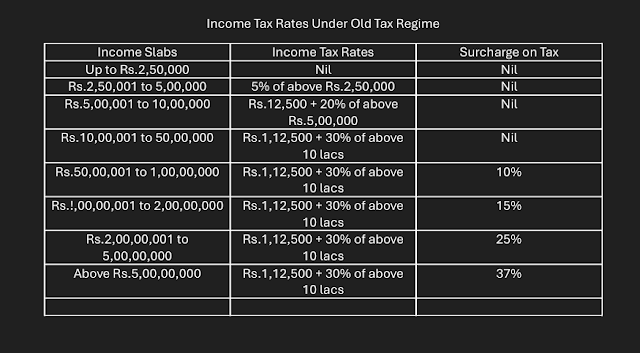
Slabs & Rates Under New Tax Regime:


Old Tax Regime


Note:-
Deductions under specific sections are allowed for those opting to be taxed under the Old Tax Regime as per the prevailing old practices, prior to the introduction of the New Regime. These allowances shall be discussed in my upcoming articles.


Saturday, 31 December 2022

Concepts of Total Revenue, Average Revenue, and Marginal Revenue

Let us study the nomenclature of revenue in three distinct concepts of total revenue, average revenue, and marginal revenue.


Total Revenue

Total revenue refers to the total receipts or income made in business during a period. It is the whole/gross income from the sale of goods and services and does not include other receipts. But normally, it is treated as the product of quantity sold multiplied by the price per unit sold.

So, Total Revenue = Total quantity multiplied by price per unit.
It can be represented as TR = Q*P, where TR is total revenue, Q is quantity sold, and P is the price per unit.

Average Revenue

Average revenue is the revenue or cost per unit of production or sales.
 
Generally, businessmen arrive at the average revenue by calculating the per-unit average of total expenses incurred in producing their output, which includes the value of their own minimum profit and other expenses like remuneration for staff and management. 

So they have to recover this average price through sales. The price is fixed by them accordingly. So, in most cases, the average revenue will be equal to the average cost of that product. Only then can they realize the full production cost.

Average revenue is calculated by dividing the total revenue by the number of units sold.

Average revenue = Total revenue / total quantity sold
AR = TR/ Q, where TR is total revenue and Q is quantity sold.

But we have already noticed that TR is Q*P as per our Total Revenue concept.

So, if we substitute TR with Q*P, then AR = Q*P / Q = P.
 
So, AR is the same as P. This is applicable in most of the cases.

Marginal Revenue

Marginal revenue is the amount of revenue received by selling one more unit of the product. It is the change in revenue divided by the change in quantity sold.

Under normal circumstances, if cost or price remains constant, then Marginal revenue should equal Average revenue. But, in most cases, it is not so.

This is because if there is plenty of supply, the prices will fall naturally. On the other hand, if there is a shortage of goods, people tend to pay more for them rather than forgo them. 

So, Marginal Revenue cannot be equal to Average Revenue.

This is why the need for the concept of Marginal revenue arose.

Marginal Revenue is calculated by subtracting the additional revenue earned from the total revenue.

Marginal revenue = P*(Q+1) - P*Q, where P is the price or cost per unit, and Q is the quantity.

So, MR = the revenue received by selling (Q+1) units minus the revenue received by selling Q units.

For example, if a vendor sells each pair of slippers at Rs.100 per unit and suppose he sold 20 units on one day and 21 units the next day. 

If you want to know your marginal revenue for the next day, on the second day he sold one extra unit. First day TR was 100*20 = 2000, and second day's TR was 100*21 = 2100. His MR for the second day is Rs.100. 

 But we are not concerned with the additional revenue if the price remains the same.

Marginal revenue makes sense only when prices keep escalating.

Suppose he sold 20 units for 100/per unit on the first day. 
The next day, he was able to sell 21 units and earned only Rs.2080 as he had to sell the extra unit at a lower price. 

Therefore, MR will be only Rs.80, because he earned an extra amount of only 80 (2080- 2000 = 80).

Key Facts about Average Revenue and Marginal Revenue

  • Calculation of Average Revenue is done to determine the price of a product. This helps in managing fixed costs and in determining production levels.
  • Marginal Revenue calculations help in determining sales volumes so that additional units of sale can be withheld after reaching a certain point by withdrawing the stocks from the market or by controlling production quantities.
  • Average revenue (AR) or Marginal revenue (MR) can increase or decrease depending on circumstances.
  • If fewer units are produced, AR will increase because many costs are fixed regardless of quantity, so the price per unit will be higher. Conversely, if more units are produced, AR per unit will be lower.
  • Similarly, MR changes with quantity at certain levels. If more units are sold beyond a certain point, marginal revenue per unit will continue to decrease. If fewer units are sold than the market demands, MR may increase per unit sold.
  • Average Revenue is calculated at a particular level of sales to determine the average price realized and to compare the cost price with the sale price.
  • Marginal Revenue is calculated to study the impact of selling each additional unit. It is used to control sales volume and maintain price.
  • AR and MR will be the same as long as the seller can maintain the same sale price for any volume of sales.
  • If the seller is unable to maintain the same price at each level of sales quantity, then AR and MR will vary.

Wednesday, 16 November 2016

Elasticity of Demand- Price Elasticity and Arc Elasticity Methods

Elasticity of Demand

The term 'elasticity of demand' refers to the responsiveness of demand to changes in the price of a given commodity, assuming all other factors remain constant.

To be more specific, the Price Elasticity, or "Elasticity of Demand," is a measure used to determine the percentage change in the quantity demanded of a good or service in response to a one percent change in the price of that good or service.

We are all aware that whenever the price of a commodity increases, we tend to curtail our demand for that commodity. So, the tool of the elasticity of demand tries to measure the magnitude of those changes in demand with reference to the changes in the price of that commodity.

The Elasticity of Demand is also known as the price elasticity of demand.

These terms are expressed in abbreviated form, either as "Ed" or "PED", respectively.

The elasticity of demand is mostly negative in almost all cases except in cases of "status goods" (Veblen goods) or "goods that have no substitutes" (Giffen goods).

Veblen goods are luxurious items that are the status symbols of extremely wealthy people.

Giffen goods are basic, non-luxury goods that have no substitutes. They are necessary for survival when the prices of other staple items rise. Bread, potatoes, and rice are essential for a common man to survive. So, he has to buy them when no food is available, even at higher prices.

How to Measure Elasticity of Demand?


The Elasticity of Demand is measured with the help of formulas just like Elasticity of Supply.

The general equation for Price Elasticity of Demand is expressed as follows:

Price Elasticity of Demand = Percentage change in quantity demanded divided by Percentage change in Price

So, if the original quantity is Q and the price is P, then Ed = (dQ/Q)/ (dP/P)

In the above equation, Ed denotes the elasticity of demand (price elasticity).

DQ refers to the change in quantity, and Q refers to the original quantity demanded.
DP points to the change in price, and P to the original price.

You can express the above equation as (Qd1/Qd) / (P1/P), where Qd1 denotes the changed quantity, and Qd denotes the original quantity. P1 is the new price, and P is the original price.

But we know that when prices increase, demand for those items decreases, and demand increases whenever prices fall. 

So, there is always an inverse relationship in the equation, except in the cases mentioned above. Hence, the equation always gives a negative value.

Two more precise, result-yielding formulas are being used by economists nowadays to measure the elasticity of demand. 

These formulas are as follows:

1) The Arc Elasticity of Demand formula
This method is used when there is no exact equation for demand available or when we are not accustomed to taking derivatives.

2) The Point-Price (or Price-Point) Elasticity of Demand formula
This method is used when we have the exact equation available, or when we are capable of calculating the derivatives of equations.

Now, let us study these two methods of calculation, one by one:

Arc Elasticity of Demand Method

The arc elasticity method gives us the average elasticity of demand between two end points of an arc on a demand curve. So, it gives us the average elasticity of demand for that curve. 

It solves the problem faced by analysts in choosing one point as the original point and the other point as the new point and, thereby, provides great relief from the dilemma faced by economists in calculating the elasticity. 

But it may not provide accurate figures, as you are taking the average of two points on a curve.

The mathematical equation for arc elasticity of demand is as follows:

{(P1+P2)/2} / {(Qd1+Qd2)/2} x (change in quantity demanded/change in price)

So, Elasticity of Demand according to this formula = (the average of prices divided by the average of quantities demanded at each price) x (change in quantity divided by change in price)

You are taking the average of multiple prices on an arc and dividing it by the average of new quantities demanded by consumers at those changed prices. Thereafter, you are multiplying the same by the derivative of (change in quantity divided by the change in price) at any point to decide the elasticity at that point.

Suppose there are two price levels for a commodity, sugar, at Rs. 40 per kg and Rs. 50 per kg.
Let us assume that at price 40, quantity demanded is 10 kg, and at 50, quantity demanded is 8kg.

Now, according to above formula, Ed = {(40 + 50)/2 divided by (10 + 8)/2} x {(10 - 8) divided by (40 - 50)} = (90/2 divided by 18/2) X (2/10) = (45 divided by 9) X (2/10) = 5 X 0.2 = 1
So Ed = 1

1% change in original price is 40 x 1/100 = 0.40 = 40 paise.

According to this formula, for every 40 paise, the quantity is assumed to change by 1%.

Point-price Elasticity of Demand Method

The point-price method is used to determine the elasticity of demand at very small changes in prices. 

It is useful in determining the price elasticity of demand at a specific point on the demand curve. 

It studies the changes in demand at price points very close to each other on a demand curve.

It also uses the same formula: the percentage change in demand divided by the percentage change in price. 

But instead of calculating each equation, we take information from the demand equation to calculate the price elasticity of demand.

Ed = percentage change in demand / percentage change in price = (Qd1/Qd) / (P1/P) = (P/Qd) x (Qd1/P1)

Now, as I mentioned above, this method is applied when we have the exact equation for the demand curve and the derivatives with respect to price.

Let us take an example:

The equation for the elasticity of demand for a demand curve Q = 5000 - 50P

So, in this equation, Qd1/P1 = 50 (per one unit of price, the change in quantity demanded is 50).

Now, suppose we have to find the point-price elasticity of demand at prices of 40 and 25.

The quantity demanded at 40 will be 5000-2000=3000. (multiplying 40 by 50)
The quantity demanded at 25 will be 5000-1250=3750. (multiplying 25 by 50)

So, Ed at 40 is -50 (40/3000) = -2000/3000= -2/3= -0.666
Ed at 25 is -50 (25/3750) = -1250/3750= -1/3= -0.333

Monday, 3 October 2016

Saving, Insurance and All About their Business

Saving and Insurance are two major economic activities, just like capital formation and other activities. These two are becoming a part of the daily lives of our modern economy. 

People have become somewhat aware of the insecurity of their lives and have begun to realize the need to secure their future by saving a little from their current consumption habits and by adopting insurance policies.

Saving


Need for Saving
If people go on consuming and spending all their income, and producers go on producing and thereby utilising all the resources of the economy, a day will come when there will be nothing more left to produce or to consume. So, people should curtail their consumption and spending habits and save some money and resources for future and emergency needs.

Meaning and Definition of Saving
"Saving is that portion of income or the excess value of the resources that has been left unused or unspent in a given period of time."

Saving is different from 'Savings'. 

Saving is an economic activity, whereas 'savings' is an accounting term. 

  • Savings is only a part of the total act of Saving.

In Keynesian economics, "Saving" has been defined as the excess of the amount or value left out of the available resources after consumption. 

So, saving is an economic term that points to the "total pool of savings" accumulated during a period of study.

  • The total saving of an economy can be considered as the total income or value of the resources less the total expenditure or value of the resources consumed by that economy in a given period.

Suppose a person 'X' received an income of Rs.6,00,000 during a year and spent a total of Rs.5,00,000 during that period; then, the balance of Rs.1,00,000 is his savings during that year.

So, when we add all the amounts of similar savings created by each and every member of that economy, it is the total Saving of that economy.

  • Saving not only constitutes the money saved but also includes the value of all the resources saved.

How to Save?

You can start with a very simple method. Try to be conscious of saving at every step. You can save even a few coins or rupees from your purchases and collect that money in a safe place. 

You will experience the wonderful results of that habit. After a month, you may find that you have saved as much as Rs.500 or even Rs.5,000 depending upon your saving habits and income. Now, you can deposit the money in a Bank. Maintain this practice continuously and make it a habit. This is the simplest thing to do if you are conscious of it.

Besides the above, you can save lump sums at periodic intervals, whenever you receive some extra income such as Overtime payments or Bonus, etc. 

Invest the saved amount in FD's or other Investment schemes.

Similarly, Producers and Manufacturers can also save much of their resources utilised by following some simple economic methods of production. 

  • Experiment with different ingredient ratios in production to minimize input quantities and costs.
  • Implement techniques such as identifying waste during material handling and/or leaks, and managing labor efficiency, etc.
The above are some ideas for saving resources.

Benefits of Saving to the Economy

Whenever people save some amount of their income, they generally deposit it in Banks or invest in some investments like FDs, stocks, or Debentures, etc.

Bank deposits lead to the availability of ample funds with Banks. 

As they are not going to be immediately withdrawn by all of them at the same time, Banks are naturally left with idle funds for a certain period. 

So, they can utilise these funds by lending to needy customers who are willing to take loans to meet their urgent requirements and then return the money along with some interest at a later time, either in instalments or in one lump sum.

In that way, Banks earn income from idle funds, and thereby, they can pay some "interest income" to their depositors in return for keeping funds in the bank.

  • So, you can see that the money saved by people not only creates extra income for themselves as well as for banks, in the form of interest, but it also helps other people meet their urgent and unforeseen expenses because of this saving habit of people.

Besides this, the money saved and deposited in banks or invested in shares, debentures, or government bonds helps businesses and industries further augment their production and add to the growth of the economy. 

  • The money saved results in increased production and in increased capital formation. 

  • The money invested in Government Bonds helps governments to utilise the money for public welfare programmes like constructing roads and dams, irrigation canals, parks, schools, and for many other purposes like providing subsidised schemes, midday meals to school children, etc., which all result in the welfare of the public and the growth of the economy as a whole.

Insurance

Importance of Insurance
Life is always uncertain. It is more so in this present-day world. People often get sick due to polluted water, air, and atmosphere that are causing or spreading so many viral infections. 

Impoverished roads and surging vehicular traffic are also a cause for concern, as they can result in accidents. Even the habits of people are deteriorating their health and resulting in premature deaths.
 
Natural calamities, accidents, thefts, and burglaries all cause huge loss to property. 

So, everything needs to be protected with a suitable insurance cover. Insurance provides great relief to people as it reimburses them an ample portion of the losses suffered by them.

Meaning and Definition of Insurance

Insurance is a helpful tool available for the security of the people. It is a kind of assurance from an undertaker to provide compensation for a certain loss suffered by the victim, like death, accident, fire, etc., in consideration of a nominal premium paid by him at the time of purchasing that assurance.

Insurance can be defined as "an arrangement or contract whereby a party or company facilitates its customers by providing financial compensation for the loss or damage incurred by them". 

It is generally represented by a policy that guarantees to indemnify against loss in consideration of a one-time or periodic premium paid by the victim.

Insurance Business and Income to Insurance Companies

An insurer bears the risk and assumes the responsibility of reimbursing the insured person a certain percentage or amount of loss, in the event of loss or damage as covered in the agreement.

As a return for their services, they collect monthly or periodic insurance premiums from their customers as their charges. 

Since people are always insecure about their lives, properties, and health, they look to these insurance coverages as their refuge. 

Many people opt to purchase these insurance policies. As a result, the insurance business generates a large pool of funds for the insurance company, from which reimbursements are made to customers who incur losses.

But the actual losses incurred by customers may not occur during the same period. Furthermore, not all customers suffer losses in reality. Only a portion of them will claim reimbursements at any given period. 

So, the companies can invest most of the money collected in profit-yielding investments or in real estate businesses and thus earn good profits from their insurance business.

The premiums are calculated to include all expenses of the company so that they can withstand any claims of huge losses and still sustain their business. 

By managing the risk in an intelligent and smart way and by evaluating the weak points minutely in all respects, the insurance companies can make ample profits and minimise their incumbent reimbursement occasions.

Different Types of Insurance Policies

There are many types of insurance policies to cover different types of losses.

a) Life Insurance
The life of a person is insured under this cover. 

Insurance companies examine the individual's health history and determine the amount to be reimbursed under the policy. Normally, younger people can opt for higher coverage with lower premiums, whereas older people are covered only for lower amounts, and even then at higher monthly premiums. This is because older people's life expectancy cannot be predicted as accurately, and it is riskier for insurance companies to underwrite their policies.

b) Health Insurance 
Health insurance policies cover hospitalization and medical expenses. 

These policies also require periodic premium payments to cover these expenses. The policies are issued annually.

The health of the person concerned is thoroughly examined before determining the amount to be reimbursed. You can renew policies annually. Most MNCs provide their employees with this health insurance coverage nowadays. Medical expenses are reimbursed by insurance companies after verifying the bills and expenses. Some expenses are not reimbursed during the process because they are deemed unnecessary by the insurers.

c) Personal Accident Insurance
Personal accident policies cover injury or death resulting from accidents. They cover only accident-related cases. 

The sum assured is generally limited to 5 or 6 years of the person's job earnings. It does not take into account other income. If the insured dies or suffers a serious, irrecoverable loss of limbs, the insurer will reimburse the full sum assured. Otherwise, only a portion of the sum assured is paid based on its norms. The insured needs to pay a premium to activate the policy.

d) Auto Insurance
Auto insurance covers the damages incurred by vehicles due to accidents or other calamities. The insurance amount is calculated based on the value of the vehicle according to its ageing factor also. A new vehicle can be insured for its whole cost with a higher premium payment. Old vehicles are insured for their residual value only with lower premium payments.

5) Other Insurance Policies
There are many other insurance options available for almost all kinds of damages or losses suffered by people. 

Some of them are Fire Insurance, Theft or Burglary Insurance, Marine Insurance (for losses suffered during shipwrecks, etc.), Fidelity Insurance (losses due to dishonesty, etc. during employment), Travel Insurance, Credit Insurance (loss due to bad debts), Crop Insurance (for farmers due to natural calamities), Workmen Compensation Insurance (loss incurred during employment due to negligence of employer resulting in accidents).

Wednesday, 28 September 2016

Meaning and Definition of Bank | Functions of Banks

A Bank is an organization that is licensed by the government or law to receive and safeguard deposits from the public, sanction loans, and to act as an intermediary in their financial transactions.

Banking institutions have been in operation since ancient history, when funds were pooled and loans were sanctioned to farmers and small traders for the overall development of economic conditions in their respective areas or kingdoms.

The modern banking system had its roots in the aftermath of the Renaissance in Europe. 

Thereafter, gradually, the modern banking concepts and practices developed from the 18th century onwards, resulting in the present banking system and practices.

Definition of Bank

A Bank can be defined as follows:

"An establishment authorized or licensed by a government to accept/ receive deposits, pay interest on those deposits, issue loans, act as an intermediary in all financial transactions, and provide other related financial services to its customers."

Functions of Banks

From the above-cited definition, it is evident that Banks perform all types of financial transactions like receiving deposits from their customers, maintaining their accounts, safeguarding those deposits and allow withdrawals or payments from those deposits, pay interest on those deposits, collection or payment of cheques and bills on their behalf, provide debit or credit cards based on those accounts to enable easy transactions of funds from any corner of the world, etc.

Now, these functions of banks can be grouped into two distinct sub-groups. 

They are primary functions and secondary functions. Let us discuss both these types of functions in detail.


Primary Functions of Banks


The primary functions are also known as the main banking functions. Banks (mainly commercial banks) perform many banking functions, such as accepting deposits and lending loans and advances in various forms.

A) Accepting Deposits


i) Current Account Deposits:
These accounts are mainly suitable for business people who need to make daily transactions, including depositing cash or checks and withdrawing cash or making bill payments by check or draft. 

These accounts are also known as Demand Accounts, as banks should pay these amounts immediately on demand by the depositors, without any limits or restrictions. 

No interest is paid on these accounts. Some service charges are debited to the account depending on the nature and volume of transactions.

ii) Savings Deposits:
Savings deposits are aimed at creating a habit of savings among people. 

These deposits provide an incentive of interest to the customers (it used to be 4% to 5%, but nowadays it is only 2 or 3 per cent). The interest gets credited to their accounts quarterly. There is a ceiling on withdrawals, presently 3 times per month. Any extra withdrawal is charged with some fees.

iii) Fixed Deposits or Term Deposits:
Fixed Deposits are also known as Term Deposits because they are deposited for a particular period or term. These deposits carry higher interest rates depending upon the period of deposit and as per the prevailing interest rates of those banks.

Deposits made for shorter periods will be paid lower interest rates, and longer periods will be paid higher rates. The current applicable rates are approximately 4% to 8%, varying according to the period.

The minimum period of deposit is 7 days and the maximum period is 10 years.
If you withdraw money before the maturity period, penalty charges are imposed, and the amount is deducted from your maturity balance, calculated as of the day of withdrawal.

iv) Recurring Term Deposits:
These are known as Recurring Deposits and are generally treated as Term Deposits and carry the same interest rates and rules as governed under Fixed Deposits.
The only difference between Recurring Deposits and Fixed Term Deposits is that in Recurring Deposits, you enjoy the facility of depositing monthly denominations of the deposits instead of a lump sum deposit.
These deposits are suitable for those who want to save money but can not afford a one-time deposit.

The interest provided ranges between 4% and 7%.

The minimum deposit accepted is Rs. 1,000, and thereafter, you can deposit in denominations of Rs.100 and above every month till maturity.
The tenure of deposits ranges from 12 months to 10 years. The interest is calculated monthly or quarterly according to the denominations deposited, and the amount will be paid on maturity of the entire period.

If you are unable to deposit an installment on time, you will be charged penalty charges from the due date to the next deposit date.

v) Money-Multiplier Deposits:
This is a new scheme launched in recent years, as far as I know.
It resembles the Term Deposits. But these schemes are launched to boost fund-pooling for Government schemes, etc.

They offer higher interest rates.
The minimum deposit is 1,000, and further amounts are in denominations of thousands. It is a one-time deposit for a fixed period. 

Premature closures attract penalties and charges similar to FDs and Other Deposit Schemes.


B) Lending of Loans and Advances

Banks lend various types of loans and advances to facilitate their customers. 

The main types of these loans and advances are classified into three categories.

i) Cash Credit:
Cash Credit is similar to a loan sanctioned generally to business people against their stocks, shares, bonds, and other securities. 

It is allowed upon opening a dedicated loan account, irrespective of their other accounts. A fixed amount of credit limit is sanctioned after evaluating the security provided.

Interest is charged on the amounts withdrawn, calculated by the number of days those particular balances are outstanding. 

Customers can enhance their credit limits by providing further securities.

ii) Overdraft:
Overdraft facilities are provided to existing account holders on request up to a certain fixed limit, based on their creditworthiness.

Whereas Cash Credit applies to business entities and traders, overdraft facilities can be obtained by salaried people, professionals, and even businesses also. 

It is generally provided after verification of his/their creditworthiness and repayment capacity. 

It can be availed for personal accounts and business accounts. 

Interest is charged on the overdraft amounts.

iii) Loans and Term Loans:
Term loans, or simply loans, are sanctioned by banks to customers either for a short-term or comparatively longer periods to facilitate their various needs upon providing some security or lien.

Some of these loans are as follows, to list a few.

a) Home Loans
b) Car Loan or Vehicle Loan
c) Educational Loan
d) Personal Loan (for short-term needs of customers like meeting marriage expenses, hospital, or medical expenses, etc.)

These loans and advances are credited to their account after approval, and the customers can withdraw the money according to their needs. 

Interest is calculated on the whole amount of the loan credited, and the loan amount is repayable in equal EMIs (including the interest amount), which is calculated according to the rates of interest prevailing at the time of the sanctioning of the loan.


Secondary Functions of Banks


Secondary functions of Banks are, generally, not performed by all banks. These may not be considered as essential functions of most commercial banks. So, they are known as Secondary Functions. These functions include many services provided by banks to facilitate customers and keep them around their banks.

The secondary functions of banks are classified into two types:

Agency Functions and Utility Functions.

The Banks charge a commission or bank charges for providing each one of these secondary functions.

1) Agency Functions of Banks


a) Discounting of Bills
Banks allow advances to their customers to facilitate their need for funds against bills of exchange drawn by them or of which they are the beneficiaries. 

The payments are made after deducting some charges. The bank will later collect the payment from the drawee of the bill or from the party that accepted the bill, by presenting it after the due date.

b) Transfer of Funds
Banks transfer funds of their customers from one account to another, from one branch to another, or to other banks both within the country and abroad at the request of customers in the form of demand drafts or mail transfers for which they charge some commission and/or bank charges.

c) Collection or Payment of Bills, etc.
Banks can also collect or pay your bills according to your instructions. 

This includes collection and payment of salaries, pensions, utility bills, interest amounts, insurance premiums, taxes, dividends, etc.

Banks charge fees for this service.

d) Portfolio Services
The banks can also provide the services of acting as your agent in the sale and purchase of stocks, bonds, and debentures, etc.

e) Other Agency Functions
Banks can also act as trustees, executors, and income-tax consultants for your deposits, deeds, wills, and funds.

2) General Utility Functions


The banks also offer other public services to facilitate and woo their customers, which are known as general utility functions.

a) Locker Facilities
Lockers are available to customers for safekeeping of their valuable possessions, like gold ornaments, title deeds, or documents.

Banks may charge some nominal fees for keeping them in the bank lockers.

b) Issue of Letter of Credit
Banks provide their customers with a letter of credit, certifying their creditworthiness, to facilitate their needs.

c) Issue of Traveller's cheques
Traveller cheques are also issued by banks to facilitate people on their journeys so that they need not carry huge cash balances with them while on a journey.

d) Underwriting of Securities
Banks undertake the function of underwriting or certifying the securities of their customers to facilitate the sales of those securities.

e) Purchase and Sale of Foreign Exchange
Banks are authorised to deal in foreign exchange transactions by RBI. 

So, they provide the services of handling the purchases and sales of foreign exchange transactions on behalf of their customers.

f) Collection of Statistics and Preparation of Project Reports
Banks collect statistics from markets on trade and commerce and can thereby provide the required information to their clients. 

They also prepare project reports for their clients.

g) Social Welfare Programmes
Banks may also indulge in the activities of public awareness, public welfare, and literacy programmes as a service to the nation.

Note:
Please collect the latest information regarding the services provided and/or the interest rates from your banks.