Saturday, 1 February 2025

Documents and Forms Needed to File Your ITR Returns

As we all know, an income tax return is a form to be filled out and submitted by each taxpayer before the due date of filing the returns as stipulated in the Income Tax Act. The return is to be filled based on information gathered from reliable documents.

Individuals, HUFs, and Firms with income above the basic exemption limit must file Income Tax Returns yearly, disclosing their total income along with perquisites and details of tax paid or deducted at source, taxable income, tax liability, or refundable dues. 

While doing so, they are required to keep certain documents on hand to support their figures.

In this article, let us study the details of such documents.

I am providing the information regarding some of those documents in the below sections.

Important Documents Needed for Submission of ITRs


Some of the documents that serve as the base for filing a return are as follows:
  • PAN card
  • Salary slips or income statements
  • Bank Statements
  • Form 16, 16A, 16B, 16C (whichever applicable)
  • Form 26AS
  • Form 15G or 15H
  • TDS certificates
  • Interest certificates, if any
  • Investment Documents
  • Documents of Loans on Houses or Assets purchased during the year
  • Any other documents needed to support the claims


Form 16

Form 16 is a document provided by an employer to his employee certifying Tax Deducted at Source during a Financial Year from the payments made to him.

This form provides details of Gross Salary and perquisites like HRA, LTA, etc. It further contains information regarding other incomes reported by the employee and exemptions granted under certain clauses of the IT Act, net taxable income, and TDS deducted.

This serves as the major document for filing the ITR.

Form 16A, Form 16B, and Form 16C

  • Forms 16a, 16b, and 16c deal with tax deducted from incomes other than salary.
  • Form 16a provides details of tax deducted from income generated through securities, investments, FDRs, Rent, etc. These are provided by the respective agent deducting the TDS.
  • Form 16b deals with tax deducted from earnings on the sale of immovable property or property dealings. The person buying the property should issue this certificate.
  • Form 16c is a TDS certificate issued by a person paying rent to his land lord. It contains the amount of gross rent payable and the amount of TDS deducted while paying the rent to his owner. The amount so deducted by the payee is to be deposited to the Income Tax Department through challan within 15 days of the deduction.


Form 26AS

Form 26AS is a consolidated statement of TDS deducted from the taxpayer's remunerations during a year by different entities (like employer, banks, and other sources). Besides TDS, this form contains figures of Self-Assessment Tax, Advance Tax remittances, and certain other financial transactions done during the said year.

This Form is available to taxpayers on the Income Tax Department's portal. As and when remittances are done, the statement gets updated simultaneously. You can download the form and tally the figures with your records and, if any discrepancies, raise the issues for solution with the department.

This form plays a crucial role while filing your ITR return. You must verify the figures before filing of the ITR return.

Form 15G

Form 15G is a document certifying that the income of the person holding it falls within the non-taxable bracket. This form is issued to individuals aged 60 and below. The holder of this form can submit it to the concerned authority (banks, etc.) for not deducting TDS from any payments that he may be receiving from them.  

Form 15H
Form 15H is for senior citizens whose income falls within the non-taxable bracket. It serves a similar purpose to that of Form 15G.

Other Documents

Other forms and documents, such as PAN cards, salary slips, TDS certificates, loan documents, interest certificates, investment certificates, rent agreements, and property sale documents, must be kept in the taxpayer's records before filing the tax returns.  

These documents are essential for verifying the figures and for accurately filing the ITR. Additionally, they may be required if the Tax Department requests them.

Wednesday, 29 January 2025

Seven Types of ITR Returns - How to Select Correct Return for Your Income Tax Filing

Introduction to ITR Returns


ITR is an abbreviation for Income Tax Return. It is a prescribed format where taxpayers provide details of their income earned during the financial year, along with the tax applicable or payable on that income. This return must be submitted to the Income Tax Department within the designated due date each year.


Who Should File Income Tax Return

An ITR is to be filed by you if you satisfy any of these following conditions:
  • If your income exceeds the minimum threshold set by the IT Act.
  • if applying for a loan or visa
  • if a tax refund is to be claimed
  • if you are receiving income from any property or assets held outside India
  • if you like to file an ITR even though your income is below the taxable limit
  • If it is a Company or Firm, irrespective of profit or loss
  • if your income includes receipts from Charitable/Endowment Trusts or other non-profit organizations, boards, trusts, etc.
  
The specific type of ITR you need to file depends on various factors, including your income, status (such as whether you are an individual, firm, company, or society), and your current domicile status.

If you are required to submit an Income Tax Return to the Indian Tax Department at the end of each financial year, it's crucial to know the correct type of return to file. While many people rely on professional tax consultants for this process, it's beneficial to understand the different types of forms available for filing with the tax authorities.

Note: The purpose of this article is to simply provide basic information regarding the different types of ITR returns and the applicable forms for your situation. Please be aware that I am not a professional; this content is intended solely for informational purposes.

Seven Types of ITR Returns


There are seven types of ITR returns, ranging from ITR-1 to ITR-7. The return you need to file depends on your total income, the nature and sources of that income, and your professional status.

ITR-1 (Sahaj)


This form applies to all salaried resident individuals and those whose total income is less than ₹50 lakh. The income includes salaries, pension, income from one-house property, and income from other sources like bank interest, deposits, agriculture income (below Rs.5,000), etc.

Who is Not Entitled to file this ITR-1:
  1. whose income exceeds 50 lacs
  2. who own more than one house
  3. individuals having income from business or profession
  4. income received from lotteries or bettings
  5. agricultural income exceeding Rs.5,000
  6. a Director or one receiving income towards capital gains
  7. one having foreign income or assets outside of India
  8. any other income not mentioned above

ITR- 2


This form applies to an individual or Hindu Undivided Family (HUF) with income from foreign assets and other sources who is not eligible to submit ITR- 1. The total income can be more than 50 lacs. He can own more than one house.

The income can include salaries, pension, income from house property, foreign income, income from lotteries and winnings, agricultural income exceeding Rs.5,000; income of spouse or child which is to be clubbed with the individual's income for assessment, income from capital gains including crypto income, etc.

Such individual need not be necessarily a Resident of India. He can be a non-resident (NRI) or resident but not ordinarily a resident (RNOR).

Who is Not Entitled to file ITR- 2 :-

Individuals with income from Business or Profession are not entitleded to file ITR- 2. (They should use either ITR- 3 or ITR- 4 as the case may be.)

ITR- 3


This form is applicable to individuals and HUF who are not entitled to submit ITR- 1, ITR- 2, or ITR- 4 provided their income includes income from Business, Profession, or Partnership Firms. Total income can exceed Rs.50 lacs.

The following are eligible to file this ITR:
  • one who is carrying on a proprietary business or profession not opted for presumptive income ( business or profession with incomes within 50 lacs are allowed to pay taxes at a presumptive rate on certain percentage of the total revenue if they do not maintain books of accounts)
  • having income from proprietary business or profession not opted for presumptive income
  • having crypto income (to be declared under business income)
  • having income from Partnership
  • their income can include salary, pension, etc.
  • any business or firm who are required to maintain books of accounts and get them audited
  • has invested in unlisted equity shares during that year
Who Cannot file ITR- 3:

Any individual with income calculated on presumptive basis can not file ITR- 3. He should file ITR-4 in such cases.

ITR- 4


This Return can be filed by an individual , HUF, or Partnership firms whose income does not exceed Rs.50 lacs but a part of the income or whole is calculated at a presumptive basis under Sections 44AD, 44AE, and 44ADA of IT Act. 

Declaration of income on presumptive basis is allowed to facilitate taxpayers indulged in small businesses (revenue not exceeding Rs.50 lacs per year).

  • Resident Indian with income from Business, Profession, Partnership (calculated on presumptive basis)
  • income from salaries, one house property, other sources including business/profession not exceeding Rs.50 lacs.
  • income as a freelancer (within that Rs.50 lac limit)
Who Cannot file ITR- 4:

  • Whose total income exceeds 50 lacs can not file ITR- 4. He should file ITR- 3 in that case.
  • If the business turnover (from which the income is derived) exceeds Rs.2 crores, he cannot file ITR- 4. In such case, he should file ITR- 3 only.
  • If owns more than one house
  • If not a Resident
  • If Director in a company
  • If owns foreign asset or income


ITR- 5


This Return is applicable to Association of Persons (AOP), Body of Individuals (BOI), Firms, and Limited Liability Partnership (LLP).
Also applies to Estates of Deceased or Insolvent, investment, and fund Business Trusts.


ITR- 6


This Income Tax Return is for Companies (provided they do not claim exemption under Section 11 of the IT Act).


ITR- 7


This Return is applicable to following individual/companies:
Section 139/4a- charitable and religiousTrusts
Section 139/4b- political parties
section 139/4c- scientific research institutions and News agencies, and Hospitals, etc.
section 139/4d- Educational institutions, Universities, Colleges, and Khadi/Village Industries  

Thursday, 23 January 2025

Income Tax Rates: Financial Year 2024-25 for Salaried and Individuals

The Income Tax Slabs and Rates were amended during previous financial years by introducing the new tax regime in 2022-2023 and making subsequent amendments.

So, from the financial year 2024-25 (AY 2025-26), our Indian government has made the new tax regime the default regime.

But, the taxpayers can opt out of the new tax regime and choose to be taxed under the old regime.

  1. For non-business taxpayers, the option can be exercised yearly while filing the ITR returns. So, they can switch back to the old regime or return to the new regime each year as per their likes and whims.
  2. However, people with income from other sources, such as business, investments, or professional services, have this option only once in their lifetime: to switch to the old regime or switch back to the new regime.

To utilize this one-time option, they must furnish Form 10-EA on or before the due date of filing the return.


Old Tax Regime vs New Tax Regime

If you choose the old tax regime, you can claim deductions under various options of Chapter VI A of the Income Tax Act, such as HRA, LIC premiums, contributions to EPF and pension schemes, interest received from banks, health insurance premiums, medical treatment, interest paid on home loans, etc.

But the above deductions are not allowed if you opt for the new regime. In such cases, only the interest paid on house loans, contributions to the Central Government Pension Scheme (14%), and contributions to the Agnipath Scheme are allowed.

In either case, you will be paying more or less the same amount of tax (as both calculations are designed to squeeze as much tax as possible, so there won't be much variation).

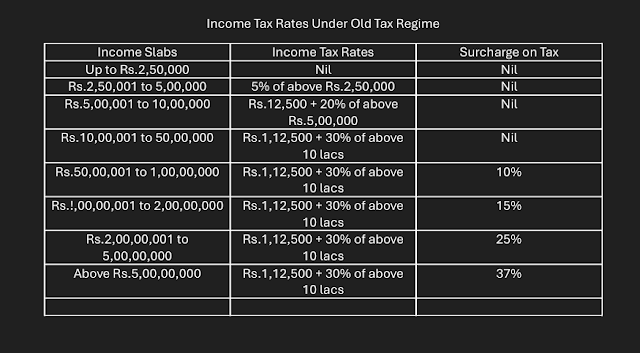
Now, let us have a look at the Income Tax slabs and Rates for Salaried Individuals.

Income Tax Slabs and Rates

I will provide the income tax rates for the new regime first, and then the rates under the old regime.

Please note that these slabs and corresponding rates apply to individuals below the age of 60 and not to others.

Slabs & Rates Under New Tax Regime:


Old Tax Regime


Note:-
Deductions under specific sections are allowed for those opting to be taxed under the Old Tax Regime as per the prevailing old practices, prior to the introduction of the New Regime. These allowances shall be discussed in my upcoming articles.


Wednesday, 16 November 2016

Elasticity of demand- Price elasticity and Arc elasticity methods

Meaning and Definition of Elasticity of Demand

The term 'elasticity of demand' refers to the responsiveness of demand to changes in the price of a given commodity assuming that all other factors are remaining the same.

To be more specific, the Price Elasticity or Elasticity of Demand is a measure or tool employed in finding out the percentage change in quantity demanded of a good or service in response to a one percent change in the price of that good or service.

We are all aware that whenever the price of a commodity gets increased, we tend to curtail our demand for that commodity. So, the tool of the elasticity of demand tries to measure the quantum of those changes in demand with reference to the changes in prices of that commodity.

The Elasticity of Demand is also known as the price elasticity of demand.

These terms are expressed in abbreviated terms either as Ed or PED respectively.

The elasticity of demand is mostly negative in almost all cases except in cases of status goods (Veblen goods) or goods that have no substitutes (Giffen goods).

How to measure Elasticity of Demand?

The Elasticity of Demand is measured with the help of formulas just like Elasticity of Supply.
The general equation for Price Elasticity of Demand is expressed as follows:

Price Elasticity of Demand = Percentage change in quantity demanded divided by Percentage change in Price
ie. Ed = (dQ/Q)/ (dP/P)
In the above equation, Ed denotes elasticity of demand (price elasticity).
DQ refers to the changed quantity and Q refers to the original quantity demanded.
DP refers to changed price and P refers to the original price.
You can express the above equation as (Qd1/Qd) / (P1/P) where Qd1 denotes changed quantity and Qd original quantity. P1 is new price and P is original price.
But, we know that the demanded quantity decreases whenever the price increases and the demanded quantity increases whenever the price falls. So, there is always an inverse ratio in the equation excepting in the cases as mentioned above. Hence, the equation always gives a negative value.

Two more precise result yielding formulas are being used by economists nowadays to measure the elasticity of demand. These formulas are mentioned below.

1) The Arc Elasticity of Demand formula
This method is used when there is no exact equation for demand available or when we are not accustomed to taking derivatives.
2) The Point-Price (or Price-Point) Elasticity of Demand formula
This method is used when we have the exact equation with us or when we are capable of calculating the derivatives of equations.

Now, let us study these two methods of calculation.

Arc Elasticity of Demand method
The arc elasticity method gives us the average elasticity of demand between the two end points of an arc on a demand curve. So, it gives us the average elasticity of demand for that curve. It solves the problem faced by analysts in choosing one point as the original point and the other point as the new point and thus provides a great relief from the dilemma faced by the economists in calculating the elasticity. But, it may not provide the accurate figures as you are taking the average of two points on a curve.
The mathematical equation for arc elasticity of demand is as follows:

{(P1+P2)/2} / {(Qd1+Qd2)/2} x (change in quantity demanded/change in price)

So, Elasticity of Demand according to this formula = (the sum total of prices divided by the sum total of quantities demanded at each price) x (change in quantity divided by change in price)
You are taking the average of different prices on an arc and dividing it with the average of new quantities demanded by consumers at those changed prices. Then, you are multiplying the same by the derivative of change in quantity divided by the change in price at any point to decide the elasticity at that point.

Suppose, there are two price levels for a commodity Sugarat Rs.40 per kg and Rs.50 per kg.
Let us assume that at price 40, quantity demanded is 10kg and at price 50, quantity demanded is 8kg.
Now, according to above formula, Ed = {(40 + 50) divided by (10 + 8)} x {(10 - 8) divided by (40 - 50)} = (90/18) x (-2/10) = 5 x (-1/5) = -1 or 1%
ie. Demand changed by 1% per each percentage change in the price.

1% change in original price is 40 x 1/100 = 0.40 = 40 paise.
So for every 40 paise, it is assumed that the quantity changes by 1% according to this formula.

Point-price Elasticity of Demand method
Point-price method is used to determine the elasticity of demand at very small changes in prices. It is useful in determining the price elasticity of demand at a specific point on the demand curve. It studies the changes in demands at price-points very closer to each other on a demand curve.

It also uses the same formula of the percentage change in demand divided by the percentage change in price. But, instead of calculating each equation, we can take information from the demand equation to calculate the price elasticity of demand.

Ed = percentage change in demand / percentage change in price = (Qd1/Qd) / (P1/P) = (P/Qd) x (Qd1/P1)
Now, as I mentioned above, this method is applied when we have the exact equation for demand curve and the derivatives per unit of price cahnge.

Let us take an example.
The equation for elasticity of demand for a demand curve Q = 5000 - 50P
So, in this equation, Qd1/P1 = -50 (per one unit of price, the change in demand quantity is 50).
Now, suppose we have to find out the point-price elasticity of demand at a price of 40 and 25.
The quantity demanded at 40 will be 5000-2000=3000.
The quantity demanded at 25 will be 5000-1250=3750.

So, Ed at 40 is -50 (40/3000) = -2000/3000= -2/3= -0.666
Ed at 25 is -50 (25/3750) = -1250/3750= -1/3= -0.333


Monday, 3 October 2016

Saving, Insurance and All About their Business

Saving and Insurance are two major economic activities just like capital formation and other activities. These two are becoming a part of the daily lives of our modern economy. People have somewhat become conscious of the insecurity of their lives and began to realise the necessity to secure their future by saving a little bit from their present consumption habits and also by adopting to insurance policies.

Saving


Need for Saving
If people go on consuming and spending all their income, and producers go on producing and thereby utilising all the resources of the economy, a day will come when there will be nothing more left to produce or to consume. So, people should curtail their consumption and spending habits and save some money and resources for future, and emergency needs.

Meaning and Definition of Saving
Saving is that portion of income or the excess value of the resource that has been left unused or unspent in a given period of time.

Saving is different from 'savings'. Saving is an economic activity whereas 'savings' is an accounting term. Savings is only a part of the total act of Saving.

In Keynesian economics, Saving has been defined as the excess of the amount or value left out of the available resources after consumption.

The total saving of an economy can be considered as the total income or value of the resources less the total expenditure or value of the resources consumed of that economy in a given period.

Suppose if a person 'X' gets an income of Rs.6,00,000 during a year and spends a total of Rs.5,00,000 during that period, then, the balance amount of Rs.1,00,000 is his Saving during that year.

So, when we add all the amounts of such Saving created by each and every member of that economy, it is the total Saving of that economy.

Saving not only constitutes the money saved, but it also includes the value of all the resources saved.

How to Save?
You can start it with a very simple method. Try to be conscious of saving at every step. You can save even a few coins or rupees from your purchases and collect that money at a safe place. You can experience the wonderful results of it. After a month, you may find out that you saved as much as Rs.500 or even Rs.5,000 depending upon saving habits and income. Now, you can deposit the money in a Bank. Maintain this practice continuously and make it a habit. This is the most simple thing to do if you are conscious of it.

Besides above, you can save amounts in lump sums at periodical intervals, whenever you receive some extra incomes such as Overtime payment or Bonus, etc. Invest some ample sum out of it in FD's or other Investment schemes.

Similarly, Producers and Manufacturers can also save much of their resources utilised by following some economic ways of production through different ratios of inputs or by implementing techniques like the location of wastages and leakages and managing labour efficiency, etc.

Benefits of Saving to the Economy
Whenever people save some amount of their income, they generally deposit the amount in Banks or invest in Investments like FDs, Stocks or Debentures, etc.

Bank deposits lead to the availability of ample funds with Banks. As they are not going to be immediately withdrawn by all of them at  the same time, Banks are naturally left with idle funds for a certain period. So, they can utilise these funds by lending to some of the needy customers who are willing to take loans to meet some of their urgent requirements and who will return the money along with some interest at a later time, either in instalments or in one lump sum.

In that way, Banks earn some income from those idle funds and they are able to pay some interest income to their depositors in return of their keeping funds in their bank.

So, you can see that the money saved by people not only creates increased income to the customers in way of interest, but they also help other people in meeting their urgent and unforeseen expenses because of this saving habit of people.

Besides this, the money saved and deposited in Banks or invested in Shares, Debentures or in Government Bonds, helps the businessmen and industries to further augment their production and add to the growth of the economy. The money saved results in increased produce and in increased capital formation. The money invested in Government Bonds helps governments to utilise the money for public welfare programmes like constructing roads and dams, irrigation canals, parks, schools and for many other purposes like providing subsidised schemes, midday meals to school children, etc. which all result in the welfare of public and the growth of the economy as a whole.

Insurance

Importance of Insurance
Life is always uncertain. It is more like that in this present-day world. People often get sick due to the polluted water, air and atmosphere that are causing or spreading so many viral infections. Even the habits of people are deteriorating their health and resulting in premature deaths. Natural calamities, accidents, thefts and burglaries all cause loss to property. So, everything needs to be protected with a suitable insurance cover. Insurance provides a great relief to people as it reimburses them an ample portion of the losses suffered by them.

Meaning and Definition of Insurance
Insurance is a healthy tool available for the security of the people. It is a kind of an assurance from an undertaker to provide some compensation for a certain loss suffered by the victim like death, accident, fire, etc. in consideration for a nominal premium paid by him at the time of purchasing that assurance.

Insurance can be defined as "an arrangement or contract whereby a party or company facilitates its customers by providing financial compensation for the loss or damage incurred by them". It is generally represented by a policy guaranteeing to indemnify the loss in consideration for the onetime premium or periodical premiums paid by the victim.

Insurance Business and Income to Insurance Companies
An insurer takes the risk of taking the responsibility of reimbursing to the insured person a certain amount of loss on the occurrence of a certain loss or damage as covered in the agreement.

As a return for these services provided by them, they collect some monthly or other periodical insurance premiums from their customers towards their charges. Since people are always insecure of their lives, properties, and health, they look to these insurance coverages as their refuge. So, many people opt to purchase these insurance policies. As a result, insurance business generates a large pool of funds to the insurance company from which they have to reimburse only a certain amount of loss or damage that takes placing during a certain period. So, they can invest most of the money collected in some profit yielding investments or in real estate businesses and thus, earn comparatively good profits from their insurance business.

By managing the risk in an intelligent and smart way and by evaluating the weak points minutely in all respects, the insurance companies can make ample profits and minimise their incumbent reimbursement occasions.

Different Types of Insurance
There are many types of insurance policies to cover different types of losses.

a) Life Insurance
The life of a person is insured under this cover. Insurance companies examine the individual's health history and decide the claim amount to be covered for reimbursement under the policy. Normally, younger people can opt for higher covers with lesser premiums whereas older people are covered only for lesser cover amounts, that too at higher monthly premiums. This is because older people's life expectancy cannot be guaranteed so accurately and it is risky for the insurance companies to undertake their covers.

b) Health Insurance 
Health insurance policies undertake the job of covering hospitalisation and medical expenses. These policies also require some premium amounts to be paid periodically for covering the expenses. The health of the person concerned is examined in all respects before deciding the amount to be reimbursed. You can renew policies even yearly also. Most of the MNC's provide their employees with this Health Insurance cover nowadays. The medical expenses are reimbursed by insurance companies after scrutinising the bills and expenses. Some expenses are not reimbursed during the process as they are deemed as unnecessary by them.

c) Personal Accident Insurance
Personal accident insurance covers injury or death due to accidents. It undertakes only accident cases. The sum assured is generally limited to 5 or 6 years income of the person from his job earnings. It does not take into account other incomes of the person. If the insured is met with death or some serious irrecoverable loss of limbs, they will reimburse the whole sum assured. Otherwise, only a part of the sum assured is paid according to their own standards of calculation. The insured needs to pay some premium amount to activate the policy.

d) Auto Insurance
Auto insurance covers the damages incurred by vehicles due to accidents or other calamities. The insurance amount is calculated based on the value of the vehicle according to its ageing factor also. A new vehicle can be insured for its whole cost with higher premium payment. Old vehicles are insured for their residual value only with lower premium payments.

5) Other Insurance Policies
There are many other insurance options available for every kind of damages or losses suffered by people. Some of them are Fire Insurance, Theft or Burglary Insurance, Marine Insurance (for losses suffered during shipwrecks, etc.), Fidelity Insurance (losses due to dishonesty, etc.during employment), Travel Insurance, Credit Insurance (loss due to bad debts), Crop Insurance (for farmers due to natural calamities), Workmen Compensation Insurance (loss incurred during employment due to negligence of employer resulting in accidents).

Wednesday, 28 September 2016

Meaning and Definition of Bank | Functions of Banks

A Bank is an organization which is licensed by government or law to receive and safeguard deposits from the public, sanction loans and to act as an intermediary in their financial transactions.

Banking institutions have been in operation since ancient history where funds were pooled and loans were sanctioned to farmers and small traders for an overall development of economic conditions in their respective areas or kingdoms.

The modern banking system had its roots in the aftermath of the Renaissance Europe. Thereafter, gradually the modern banking concepts and practices developed from the 18th century onwards resulting in the present banking system and practices.

Definition of Bank
A Bank can be defined as follows:

"An establishment authorized or licensed by a government to accept/ receive deposits, pay interest on those deposits, issue loans, act as an intermediary in all financial transactions, and provide other related financial services to its customers."

Functions of Banks
From the above definition, it is evident that Banks perform all types of financial transactions like receiving deposits from their customers, maintaining their accounts, safeguarding those deposits and allow withdrawals or payments from those deposits, pay interest on those deposits, collection or payment of cheques and bills on their behalf, provide debit or credit cards based on those accounts to enable easy transactions of funds from any corner of the world, etc.

Now, these functions of banks can be grouped into two distinct sub-groups. They are primary functions and secondary functions. Let us discuss both these types of functions.


Primary Functions of Banks

The primary functions are also known as the main banking functions. Banks (mainly commercial banks) perform many banking functions like accepting deposits and lending of loans and advances in various forms.

A) Accepting Deposits

i) Current Account Deposits:
These accounts are mainly suitable for business people who need to make daily transactions of depositing cash or cheques and to withdraw cash or make their bill payments through cheques and drafts. These accounts are also known as Demand Accounts, as the banks should pay these amounts immediately on demand by the depositors without any limit or restrictions. No interest is paid on these accounts. Some service charges are debited to the account depending upon the transactions.

ii) Savings Deposits:
Savings deposits are aimed at creating a habit of savings among people. These deposits provide an incentive of interest to the customers (4% to 5% normally) which are credited to their accounts quarterly. There is a ceiling on withdrawals, presently 3 times per month. Any extra withdrawal is charged with some fees.

iii) Fixed Deposits or Term Deposits:
Fixed Deposits are also known as Term Deposits because they are deposited for a particular period or term. These deposits carry higher interest rates depending upon the period of deposit and as per the prevailing rates of interests of those banks.
Deposits made for lesser periods will be paid lower interest rates and higher periods are paid higher rates. The present rates applicable are 4% to 8% approximately varying according to periods.
The minimum period of deposit is 7 days and maximum period is 10 years.
If you withdraw money before maturity period, penalty charges are imposed and the amount is deducted from your maturity balance calculated as on that day of withdrawal.

iv) Recurring Term Deposits:
These are known as Recurring Deposits and are generally treated as Term Deposits and carry the same interest rates and rules as governed under Fixed Deposits.
The only difference between Recurring Deposits and Fixed Term Deposits is that in Recurring Deposits, you enjoy the facility of depositing monthly denominations of the deposits instead of a lump sum deposit.
These deposits are suitable for those who want to save money, but can not afford a one time deposit.
The minimum deposit accepted is Rs.1,000 and thereafter, you can deposit in denominations of Rs.100 and above every month till maturity.
The tenure of deposits ranges from 12 months to 10 years. The interest is calculated monthly or quarterly according to the denominations deposited and the amount will be paid on maturity of the entire period.
If you are unable to deposit an installment timely, you will be charged penalty charges from the due date to the next deposit date.

B) Lending of Loans and Advances
Banks lend various types of loans and advances to facilitate their customers. The main types of these loans and advances are classified into three types.

i) Cash Credit:
Cash Credit is a type of loan sanctioned generally to business people against their stocks, shares, bonds and other securities. It is allowed to current account holders as well as outsiders also. A fixed amount of credit limit is sanctioned after evaluating the security provided. The interest is charged on the amounts withdrawn, calculated by the number of days  those particular balances are outstanding. The customers can enhance their credit limits by providing further securities.

ii) Overdraft:
Overdraft facilities are provided to existing current account holders on their request up to a certain fixed limit after providing some personal guarantee or security. It is generally provided after assessing his creditworthiness and repayment capacity. It can be availed both for personal accounts and business accounts. Interest is charged on the overdraft amounts.

iii) Loans and Term Loans:
Term loans or simply loans are sanctioned by banks to customers either for a short-term or comparatively longer terms to facilitate their various needs against some security or lien.
Some of these loans are as follows to list a few.

a) Home Loans
b) Car Loan or Vehicle Loan
c) Educational Loan
d) Personal Loan (for short term needs of customers like meeting marriage expenses, hospital or medical expenses, etc.)

These loans and advances are credited to their account after approval and the customers can withdraw the money according to their needs. Interest is calculated on the whole amount credited and the loan amount is refundable in equal EMIs (including interest amount) which is calculated according to the rates of interest prevailing at the time of sanction of the loan.


Secondary Functions of Banks

Secondary functions of Banks are, generally, not performed by all banks. These may not be considered as essential functions of most commercial banks. So, they are known as Secondary Functions. These functions include many services provided by banks to facilitate customers and keep them around their banks.

The secondary functions of banks are classified into two types known as Agency Functions and Utility Functions.

The Banks charge their commission or bank charges for providing each one of these secondary functions.

1) Agency Functions of Banks

a) Discounting of Bills
Banks allow advances to their customers to facilitate their need for funds against bills of exchange drawn by them or of which they are the beneficiaries. The payments are made after deducting some charges. The bank will later collect the payment from the drawee of the bill or from the party that accepted the bill by presenting it after the maturity of the period.

b) Transfer of Funds
Banks transfer funds of their customers from one account to another, from one branch to another or to other banks both within the country or abroad at the request of customers in the form of demand drafts or mail transfers for which they charge some commission and bank charges.

c) Collection or Payment of Bills, etc.
Banks can also collect or pay your bills according to your instructions. This includes collection and payment of salaries, pensions, utility bills, interest amounts, insurance premiums, taxes, dividends, etc. Banks charge their charges for this service.

d) Portfolio Services
The banks can also provide the services of acting as your agent in the sales and purchase of stocks, bonds, and debentures,etc.

e) Other agency functions
Banks can also act as the trustees, executors and income-tax consultants of your deposits, deeds, wills and funds.

2) General Utility Functions

The banks offer some more general public services to facilitate their customers which are known as general utility functions.

a) Locker Facilities
Lockers are allowed to customers for safeguarding their valuable possessions like gold ornaments, title-deeds or documents, etc. by keeping them in the bank lockers.

b) Issue of Letter of Credit
Banks provide their customers with a letter of credit certifying their creditworthiness to facilitate their needs.

c) Issue of Traveller's cheques
Traveller cheques are also issued by banks to facilitate people on their journeys so that they need not carry huge cash balances with them while on a journey.

d) Underwriting of Securities
Banks undertake the function of underwriting or certifying the securities of their customers to facilitate the sales of those securities.

e) Purchase and Sale of Foreign Exchange
Banks are authorised to deal in the foreign exchange transactions by RBI. So, they provide the services of dealing with the purchases and sales of foreign exchange on behalf of their customers.

f) Collection of statistics and preparation of project reports
Banks collect statistics from markets regarding trade and commerce and thereby can provide the required information to their clients. They also prepare the project reports for their clients.

g) Social welfare programmes
Banks also indulge in activities of public awareness, public welfare, and literacy programmes as a service to the nation.


Monday, 30 May 2016

A Study of the Role of Money in Economy

By role of money, I refer to the part played by money in our modern economy.

Money is regarded as the pulse of our life. Without money, there is no life or activity in this modern economy. Everything is related to money here. From morning to evening, from birth to death, you need money for something or other.

Money plays an important role in our economy. It motivates and influences all our economic activities; consumption, production, supply, demand, and distribution are all influenced by the supply and power of money in any economy.


  • As a consumer, you can purchase goods and services and make payments in terms of money which is universally accepted by one and all. 
  • As a unit of exchange and as a measure of value, money guarantees for the real value of all your goods and services.
  • To be able to pay in terms of money, you need to procure money. So, you will be earning money by doing some business or other; or working as an employee in a company or by doing some labour. Thus money gets generated and rotated through our activities.
  • Money facilitates economic activity, creating businesses either in the manufacturing sector or in the services sector and thereby creating more jobs for more people in different fields. This in turn boosts the economy. 
  • Money further facilitates and ensures that goods and services are produced to meet the demands of consumers. Consumers can opt for better products by choosing from multiple options as they are free to buy as and when they desire to do so. This is possible because of the storage value of money.
  • Money facilitates the easy transfer and distribution of goods and services to any corner of the world as you can make payments through money at any place.
  • Money plays another important role of equalizing the marginal utilities of consumers. Consumers are able to shift towards higher utility-providing goods by discarding lower marginal utility products as they can distinguish the differences in utilities with the help of money as a standard of value which sets the prices of goods in terms of money.
  • So, money facilitates a rational distribution of the income of consumers among different needs and necessities. The buyer can draw a picture of his income and expenses and match them with utmost utility levels within the given income.
  • Money makes the maintenance of accounts of any business very easy as everything is accounted in terms of money. This facilitates accurate calculation of expenses and income of any business and aids in the fixation of the prices of their products.
  • Money helps governments in collecting their taxes and in planning for their projects as they can estimate their Revenue and prepare their Budgets accordingly thereby enabling them in boosting their economy.
  • Further, money enables a continuous flow of funds from one person to another and from one corner to another corner of the country or the world.

To sum up, money has different roles in our economy. It acts as the power of purchases. It serves as a storage of value. It facilitates a continuous flow of economic activities. It aids in the progress of the economy as a whole.