Monday, 26 January 2026

Tax Residency Certificate: How to Obtain Form 10FB

 Form 10FA is an application to request a Tax Residency Certificate from the Income Tax Department. After scrutiny and approval, the TRC is issued in Form 10FB by the tax department.

Purpose of Tax Residency Certificate (Form 10FB)

To prevent double taxation, Sections 90, 90A, and 91 provide taxpayers with options to claim benefits and pay tax on their foreign income only once. Both tax credit/refund and relief are applicable, depending on the presence (or absence) of DTAA with the country/organisation, or the nature of the business of the applicant with that entity. DTAA stands for the Double Taxation Avoidance Agreement under Section 90 of the Indian IT Act.

A tax residency certificate is mandatory for obtaining relief from tax being deducted by foreign agencies (to avoid duplicate tax deductions) in which you have certain interests. The certificate (Form 10FB) is provided after your application gets approved by the department. It may take two to four weeks, depending on your activities.

Filling out and submitting the application form (10FA) typically takes 15 to 30 minutes, provided you have all the necessary details and supporting documents ready. The process is straightforward and requires basic information such as PAN, address, and the financial year for which the certificate is needed.

Factors Affecting Time and Process 


Procedure: 

The time depends on having the necessary documents ready, such as a PAN, proof of residence, and details of the income source, all of which must be readily available. As proof of residence, you can provide the recent (last month) electricity bill. Sometimes, the bills bear the builder's name or the owner's name. In such circumstances, you need to support the bill with a sale deed or rental agreement (if a tenant).  

Document Upload: 

You will need to upload supporting documents in PDF or ZIP format (max size 5MB each). 

Verification: 

After filling the form, you must verify it using an OTP sent to your registered mobile and/or email, or via digital signature (DSC). 

Processing Time: 

While the filing time is short, obtaining the Certificate of Residence (Form 10FB) after submitting Form 10FA can take 2 to 4 weeks. 

The Tax Residency is valid for the year for which you apply. So, you should seek a fresh certificate each year if you are in need of it.


Steps to Complete Form 10FA Online 


1. Login: Log in to the Income Tax e-Filing portal.
 
If you don't have an account on the Income Tax Portal, you need to create one or use other offline methods as mentioned at the end of this article. To create an account, you should provide your PAN number, mobile number, and other required details. You should also link your Aadhar Card to use the services.

2. Navigate: Go to 'e-File', 'Income Tax Forms', and click 'File Income Tax Forms'. 

3. Form Selection: Search for and select Form 10FA. 

4. Fill Data: Enter personal details, PAN, address, and financial year details. 

5. Upload Documents: Upload supporting documents. 

6. Verify & Submit: Verify using OTP (mobile/email) and submit.

You will be notified when the certificate is ready for download.

Obtaining TRC through Offline Mode

If you find it difficult to procure the certificate through an online application, you can take the services of any Tax Consultant or Chartered Accountant. They may charge some nominal fees for this work. You will have to provide the details and the documents necessary for this purpose. ClearTax is a consultancy firm that offers these services, as per my knowledge. They can do all your income tax jobs.

Tuesday, 20 January 2026

Do You Know? Income Tax Department Indulges in NUDGE Awareness Campaigns


In common usage, a nudge means the act of pushing your friend/neighbor with the elbow. It is a way of drawing his attention to something that you want to. This act of pushing is adopted by our (Indian) Income Tax Department to alert taxpayers to rectify their mistakes before issuing any notices.


The NUDGE in Indian Income Tax stands for "Non-Intrusive Usage of Data to Guide and Enable". It is a campaign by the Central Board of Direct Taxes (CBDT) that uses advanced data analytics to identify potential discrepancies in a taxpayer's filed return and encourages them to voluntarily correct the errors.

According to TOI's article (linked at the bottom) dated December 25, some taxpayers received these SMS's/emails. 

Key Aspects of the NUDGE Campaign:

Advisory Nature: 

The communication (via SMS and email) is advisory and not a formal legal notice or the start of an intrusive investigation. It reflects a "trust-first" approach by the tax department to promote voluntary compliance.

Data-Driven: 

The campaign utilises data analytics and information received from various sources, including international information exchange agreements (such as AEOI, CRS, and FATCA), to identify high-risk cases.

Specific Issues: 

The campaign targets particular issues, such as:

  • Ineligible deductions or exemptions claimed (e.g., bogus donations to unrecognised political parties).
  • Incorrect or invalid Permanent Account Numbers (PANs) of donees or other entities.
  • Non-disclosure or underreporting of foreign assets and foreign source income in the ITR's Schedule FA and Schedule FSI.
  • Other issues of importance.

What to Do When You Receive a Nudge Message 

Taxpayers who receive a NUDGE message are advised to review their Income Tax Returns (ITRs) for discrepancies and, if necessary, file a revised return within the specified deadline (e.g., by December 31 for the relevant assessment year) to avoid potential penalties or a detailed investigation later.

Taxpayers are advised to carefully verify all deductions and exemptions claimed on their returns against supporting documents to ensure accuracy and compliance.

If discrepancies are identified, taxpayers should correct the figures and file a revised return on or before December 31 to avoid penalties, additional tax liabilities, or further scrutiny by the department.

Individuals whose claims are genuine and in accordance with the law do not need to take any further action. 

However, they may retain documentation in case verification is requested by the department.

Key deductions under scrutiny include House Rent Allowance, donations to political parties, foreign source receipts/payments, and exemptions under the Double Taxation Avoidance Agreement.

We should note that the NUDGE initiative is part of the department’s trust-first approach, which aims to provide taxpayers with an opportunity to voluntarily correct errors in their returns without facing immediate enforcement action. So, we should be thankful and appreciate their cooperation.

For some more news, please read this article from The Times of India dated December 25, 2025.

Monday, 19 January 2026

What is AIS in Income Tax Returns and How it Differs from Form 26AS

A sample of the front page


 An AIS, or Annual Information Statement, is a detailed report introduced by India's Income Tax Department. 

It enables a consolidated view of a taxpayer's financial transactions executed during a year, aiming to encourage voluntary compliance and assist in the pre-filling and submission of Income Tax Returns (ITR). 

This auto-generated statement is available on the Income Tax Portal. This information is compiled automatically by the Tax Department from data collected from various third-party entities that are legally mandated to report financial transactions associated with a taxpayer's Permanent Account Number. 

The AIS contains two Parts- A (providing general information of the taxpayer) and B (financial transactions done by or related to him).

The length of the statement depends on the volume of transactions mentioned under 57 categories of income and expenses in Part B.

Key Details and Features

1. Comprehensive Data Compilation

The AIS includes a broad range of information reported by various entities (like banks, employers, mutual funds, stock exchanges, etc.) using your Permanent Account Number (PAN).

Even the LIC and PF organisations provide their statements regarding your premiums, contributions, etc., to the Tax Department.

 The data thus provided includes:

Salary, interest (from savings accounts, FDs, etc.), and dividend income, if any.

LIC premiums paid in a year and maturity/claims paid.

PF contributions and funds drawn during the said year.

Details of Securities and Mutual Fund transactions.

High-value transactions involving property purchases/sales and large cash deposits/withdrawals.

Foreign Remittances and purchases of foreign currency.

Details of tax payments like TDS, TCS, advance tax, and self-assessment tax.

Any other financial transactions executed during that year with other entities.

2. Taxpayer Information Summary (TIS)

The AIS is accompanied by a simplified summary called the TIS, which provides an aggregated, category-wise view of your financial data. This summary enables the calculation of Income Tax dues and the balance amount of tax payable. 

The derived value from TIS is used for pre-filling your ITR.

3. Feedback Mechanism for Rectification and Claims

Taxpayers can submit online feedback if they find any incorrect, duplicated, or unfamiliar information in the AIS. 

This feature helps in reconciling data and ensures accuracy before filing the ITR.

4. Accessibility and Available Formats for Download

The AIS can be accessed via the official Income Tax e-filing portal (navigating to the Annual Information Statement under the "Services" tab).

It can be downloaded in various formats, including PDF, JSON, and CSV. 

A mobile app, "AIS for Taxpayer," is also available and can be downloaded from the Google Play Store or the Apple App Store.

AIS vs. Form 26AS

AIS is an extension and a more detailed version of the traditional Form 26AS. While Form 26AS primarily focuses on TDS/TCS details, AIS captures a much wider array of financial information, often including transactions where no tax was deducted. 

Form 26AS is the old format, which has been revamped and enhanced into a comprehensive format type now designated as the Annual Information Statement.

Form 26AS may become obsolete in due course.

Importance of AIS for Taxpayers

Reviewing your AIS is crucial before filing your ITR to ensure all income sources are accurately reported, which helps in:

  • Avoiding omissions or under-reporting of income
  • Minimizing the risk of receiving tax notices from the Income Tax Department
  • Ensuring that the tax credits claimed match the data available to the tax authorities. 

You can access your AIS from the IncomeTax Portal or through the mobile app.

Saturday, 1 February 2025

Documents and Forms Needed to File Your ITR Returns

As we all know, an income tax return is a form to be filled out and submitted by each taxpayer before the due date of filing the returns as stipulated in the Income Tax Act. The return is to be filled based on information gathered from reliable documents.

Individuals, HUFs, and Firms with income above the basic exemption limit must file Income Tax Returns yearly, disclosing their total income along with perquisites and details of tax paid or deducted at source, taxable income, tax liability, or refundable dues. 

While doing so, they are required to keep certain documents on hand to support their figures.

In this article, let us study the details of such documents.

I am providing the information regarding some of those documents in the below sections.

Important Documents Needed for Submission of ITRs


Some of the documents that serve as the base for filing a return are as follows:
  • PAN card
  • Salary slips or income statements
  • Bank Statements
  • Form 16, 16A, 16B, 16C (whichever applicable)
  • Form 26AS
  • Form 15G or 15H
  • TDS certificates
  • Interest certificates, if any
  • Investment Documents
  • Documents of Loans on Houses or Assets purchased during the year
  • Any other documents needed to support the claims


Form 16

Form 16 is a document provided by an employer to his employee certifying Tax Deducted at Source during a Financial Year from the payments made to him.

This form provides details of Gross Salary and perquisites like HRA, LTA, etc. It further contains information regarding other incomes reported by the employee and exemptions granted under certain clauses of the IT Act, net taxable income, and TDS deducted.

This serves as the major document for filing the ITR.

Form 16A, Form 16B, and Form 16C

  • Forms 16a, 16b, and 16c deal with tax deducted from incomes other than salary.
  • Form 16a provides details of tax deducted from income generated through securities, investments, FDRs, Rent, etc. These are provided by the respective agent deducting the TDS.
  • Form 16b deals with tax deducted from earnings on the sale of immovable property or property dealings. The person buying the property should issue this certificate.
  • Form 16c is a TDS certificate issued by a person paying rent to his land lord. It contains the amount of gross rent payable and the amount of TDS deducted while paying the rent to his owner. The amount so deducted by the payee is to be deposited to the Income Tax Department through challan within 15 days of the deduction.


Form 26AS

Form 26AS is a consolidated statement of TDS deducted from the taxpayer's remunerations during a year by different entities (like employer, banks, and other sources). Besides TDS, this form contains figures of Self-Assessment Tax, Advance Tax remittances, and certain other financial transactions done during the said year.

This Form is available to taxpayers on the Income Tax Department's portal. As and when remittances are done, the statement gets updated simultaneously. You can download the form and tally the figures with your records and, if any discrepancies, raise the issues for solution with the department.

This form plays a crucial role while filing your ITR return. You must verify the figures before filing of the ITR return.

Form 15G

Form 15G is a document certifying that the income of the person holding it falls within the non-taxable bracket. This form is issued to individuals aged 60 and below. The holder of this form can submit it to the concerned authority (banks, etc.) for not deducting TDS from any payments that he may be receiving from them.  

Form 15H
Form 15H is for senior citizens whose income falls within the non-taxable bracket. It serves a similar purpose to that of Form 15G.

Other Documents

Other forms and documents, such as PAN cards, salary slips, TDS certificates, loan documents, interest certificates, investment certificates, rent agreements, and property sale documents, must be kept in the taxpayer's records before filing the tax returns.  

These documents are essential for verifying the figures and for accurately filing the ITR. Additionally, they may be required if the Tax Department requests them.

Wednesday, 29 January 2025

Seven Types of ITR Returns - How to Select Correct Return for Your Income Tax Filing

Introduction to ITR Returns


ITR is an abbreviation for Income Tax Return. It is a prescribed format where taxpayers provide details of their income earned during the financial year, along with the tax applicable or payable on that income. This return must be submitted to the Income Tax Department within the designated due date each year.


Who Should File Income Tax Return

An ITR is to be filed by you if you satisfy any of these following conditions:
  • If your income exceeds the minimum threshold set by the IT Act.
  • if applying for a loan or visa
  • if a tax refund is to be claimed
  • if you are receiving income from any property or assets held outside India
  • if you like to file an ITR even though your income is below the taxable limit
  • If it is a Company or Firm, irrespective of profit or loss
  • if your income includes receipts from Charitable/Endowment Trusts or other non-profit organizations, boards, trusts, etc.
  
The specific type of ITR you need to file depends on various factors, including your income, status (such as whether you are an individual, firm, company, or society), and your current domicile status.

If you are required to submit an Income Tax Return to the Indian Tax Department at the end of each financial year, it's crucial to know the correct type of return to file. While many people rely on professional tax consultants for this process, it's beneficial to understand the different types of forms available for filing with the tax authorities.

Note: The purpose of this article is to simply provide basic information regarding the different types of ITR returns and the applicable forms for your situation. Please be aware that I am not a professional; this content is intended solely for informational purposes.

Seven Types of ITR Returns


There are seven types of ITR returns, ranging from ITR-1 to ITR-7. The return you need to file depends on your total income, the nature and sources of that income, and your professional status.

ITR-1 (Sahaj)


This form applies to all salaried resident individuals and those whose total income is less than ₹50 lakh. The income includes salaries, pension, income from one-house property, and income from other sources like bank interest, deposits, agriculture income (below Rs.5,000), etc.

Who is Not Entitled to file this ITR-1:
  1. whose income exceeds 50 lacs
  2. who own more than one house
  3. individuals having income from business or profession
  4. income received from lotteries or bettings
  5. agricultural income exceeding Rs.5,000
  6. a Director or one receiving income towards capital gains
  7. one having foreign income or assets outside of India
  8. any other income not mentioned above

ITR- 2


This form applies to an individual or Hindu Undivided Family (HUF) with income from foreign assets and other sources who is not eligible to submit ITR- 1. The total income can be more than 50 lacs. He can own more than one house.

The income can include salaries, pension, income from house property, foreign income, income from lotteries and winnings, agricultural income exceeding Rs.5,000; income of spouse or child which is to be clubbed with the individual's income for assessment, income from capital gains including crypto income, etc.

Such individual need not be necessarily a Resident of India. He can be a non-resident (NRI) or resident but not ordinarily a resident (RNOR).

Who is Not Entitled to file ITR- 2 :-

Individuals with income from Business or Profession are not entitleded to file ITR- 2. (They should use either ITR- 3 or ITR- 4 as the case may be.)

ITR- 3


This form is applicable to individuals and HUF who are not entitled to submit ITR- 1, ITR- 2, or ITR- 4 provided their income includes income from Business, Profession, or Partnership Firms. Total income can exceed Rs.50 lacs.

The following are eligible to file this ITR:
  • one who is carrying on a proprietary business or profession not opted for presumptive income ( business or profession with incomes within 50 lacs are allowed to pay taxes at a presumptive rate on certain percentage of the total revenue if they do not maintain books of accounts)
  • having income from proprietary business or profession not opted for presumptive income
  • having crypto income (to be declared under business income)
  • having income from Partnership
  • their income can include salary, pension, etc.
  • any business or firm who are required to maintain books of accounts and get them audited
  • has invested in unlisted equity shares during that year
Who Cannot file ITR- 3:

Any individual with income calculated on presumptive basis can not file ITR- 3. He should file ITR-4 in such cases.

ITR- 4


This Return can be filed by an individual , HUF, or Partnership firms whose income does not exceed Rs.50 lacs but a part of the income or whole is calculated at a presumptive basis under Sections 44AD, 44AE, and 44ADA of IT Act. 

Declaration of income on presumptive basis is allowed to facilitate taxpayers indulged in small businesses (revenue not exceeding Rs.50 lacs per year).

  • Resident Indian with income from Business, Profession, Partnership (calculated on presumptive basis)
  • income from salaries, one house property, other sources including business/profession not exceeding Rs.50 lacs.
  • income as a freelancer (within that Rs.50 lac limit)
Who Cannot file ITR- 4:

  • Whose total income exceeds 50 lacs can not file ITR- 4. He should file ITR- 3 in that case.
  • If the business turnover (from which the income is derived) exceeds Rs.2 crores, he cannot file ITR- 4. In such case, he should file ITR- 3 only.
  • If owns more than one house
  • If not a Resident
  • If Director in a company
  • If owns foreign asset or income


ITR- 5


This Return is applicable to Association of Persons (AOP), Body of Individuals (BOI), Firms, and Limited Liability Partnership (LLP).
Also applies to Estates of Deceased or Insolvent, investment, and fund Business Trusts.


ITR- 6


This Income Tax Return is for Companies (provided they do not claim exemption under Section 11 of the IT Act).


ITR- 7


This Return is applicable to following individual/companies:
Section 139/4a- charitable and religiousTrusts
Section 139/4b- political parties
section 139/4c- scientific research institutions and News agencies, and Hospitals, etc.
section 139/4d- Educational institutions, Universities, Colleges, and Khadi/Village Industries  

Thursday, 23 January 2025

Income Tax Rates: Financial Year 2024-25 for Salaried and Individuals

The Income Tax Slabs and Rates were amended during previous financial years by introducing the new tax regime in 2022-2023 and making subsequent amendments.

So, from the financial year 2024-25 (AY 2025-26), our Indian government has made the new tax regime the default regime.

But, the taxpayers can opt out of the new tax regime and choose to be taxed under the old regime.

  1. For non-business taxpayers, the option can be exercised yearly while filing the ITR returns. So, they can switch back to the old regime or return to the new regime each year as per their likes and whims.
  2. However, people with income from other sources, such as business, investments, or professional services, have this option only once in their lifetime: to switch to the old regime or switch back to the new regime.

To utilize this one-time option, they must furnish Form 10-EA on or before the due date of filing the return.


Old Tax Regime vs New Tax Regime

If you choose the old tax regime, you can claim deductions under various options of Chapter VI A of the Income Tax Act, such as HRA, LIC premiums, contributions to EPF and pension schemes, interest received from banks, health insurance premiums, medical treatment, interest paid on home loans, etc.

But the above deductions are not allowed if you opt for the new regime. In such cases, only the interest paid on house loans, contributions to the Central Government Pension Scheme (14%), and contributions to the Agnipath Scheme are allowed.

In either case, you will be paying more or less the same amount of tax (as both calculations are designed to squeeze as much tax as possible, so there won't be much variation).

Now, let us have a look at the Income Tax slabs and Rates for Salaried Individuals.

Income Tax Slabs and Rates

I will provide the income tax rates for the new regime first, and then the rates under the old regime.

Please note that these slabs and corresponding rates apply to individuals below the age of 60 and not to others.

Slabs & Rates Under New Tax Regime:


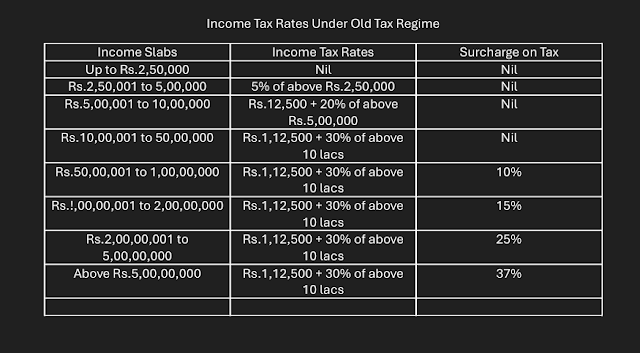
Old Tax Regime


Note:-
Deductions under specific sections are allowed for those opting to be taxed under the Old Tax Regime as per the prevailing old practices, prior to the introduction of the New Regime. These allowances shall be discussed in my upcoming articles.


Saturday, 31 December 2022

Concepts of Total Revenue, Average Revenue, and Marginal Revenue

Let us study the nomenclature of revenue in three distinct concepts of total revenue, average revenue, and marginal revenue.


Total Revenue

Total revenue refers to the total receipts or income made in business during a period. It is the whole/gross income from the sale of goods and services and does not include other receipts. But normally, it is treated as the product of quantity sold multiplied by the price per unit sold.

So, Total Revenue = Total quantity multiplied by price per unit.
It can be represented as TR = Q*P, where TR is total revenue, Q is quantity sold, and P is the price per unit.

Average Revenue

Average revenue is the revenue or cost per unit of production or sales.
 
Generally, businessmen arrive at the average revenue by calculating the per-unit average of total expenses incurred in producing their output, which includes the value of their own minimum profit and other expenses like remuneration for staff and management. 

So they have to recover this average price through sales. The price is fixed by them accordingly. So, in most cases, the average revenue will be equal to the average cost of that product. Only then can they realize the full production cost.

Average revenue is calculated by dividing the total revenue by the number of units sold.

Average revenue = Total revenue / total quantity sold
AR = TR/ Q, where TR is total revenue and Q is quantity sold.

But we have already noticed that TR is Q*P as per our Total Revenue concept.

So, if we substitute TR with Q*P, then AR = Q*P / Q = P.
 
So, AR is the same as P. This is applicable in most of the cases.

Marginal Revenue

Marginal revenue is the amount of revenue received by selling one more unit of the product. It is the change in revenue divided by the change in quantity sold.

Under normal circumstances, if cost or price remains constant, then Marginal revenue should equal Average revenue. But, in most cases, it is not so.

This is because if there is plenty of supply, the prices will fall naturally. On the other hand, if there is a shortage of goods, people tend to pay more for them rather than forgo them. 

So, Marginal Revenue cannot be equal to Average Revenue.

This is why the need for the concept of Marginal revenue arose.

Marginal Revenue is calculated by subtracting the additional revenue earned from the total revenue.

Marginal revenue = P*(Q+1) - P*Q, where P is the price or cost per unit, and Q is the quantity.

So, MR = the revenue received by selling (Q+1) units minus the revenue received by selling Q units.

For example, if a vendor sells each pair of slippers at Rs.100 per unit and suppose he sold 20 units on one day and 21 units the next day. 

If you want to know your marginal revenue for the next day, on the second day he sold one extra unit. First day TR was 100*20 = 2000, and second day's TR was 100*21 = 2100. His MR for the second day is Rs.100. 

 But we are not concerned with the additional revenue if the price remains the same.

Marginal revenue makes sense only when prices keep escalating.

Suppose he sold 20 units for 100/per unit on the first day. 
The next day, he was able to sell 21 units and earned only Rs.2080 as he had to sell the extra unit at a lower price. 

Therefore, MR will be only Rs.80, because he earned an extra amount of only 80 (2080- 2000 = 80).

Key Facts about Average Revenue and Marginal Revenue

  • Calculation of Average Revenue is done to determine the price of a product. This helps in managing fixed costs and in determining production levels.
  • Marginal Revenue calculations help in determining sales volumes so that additional units of sale can be withheld after reaching a certain point by withdrawing the stocks from the market or by controlling production quantities.
  • Average revenue (AR) or Marginal revenue (MR) can increase or decrease depending on circumstances.
  • If fewer units are produced, AR will increase because many costs are fixed regardless of quantity, so the price per unit will be higher. Conversely, if more units are produced, AR per unit will be lower.
  • Similarly, MR changes with quantity at certain levels. If more units are sold beyond a certain point, marginal revenue per unit will continue to decrease. If fewer units are sold than the market demands, MR may increase per unit sold.
  • Average Revenue is calculated at a particular level of sales to determine the average price realized and to compare the cost price with the sale price.
  • Marginal Revenue is calculated to study the impact of selling each additional unit. It is used to control sales volume and maintain price.
  • AR and MR will be the same as long as the seller can maintain the same sale price for any volume of sales.
  • If the seller is unable to maintain the same price at each level of sales quantity, then AR and MR will vary.